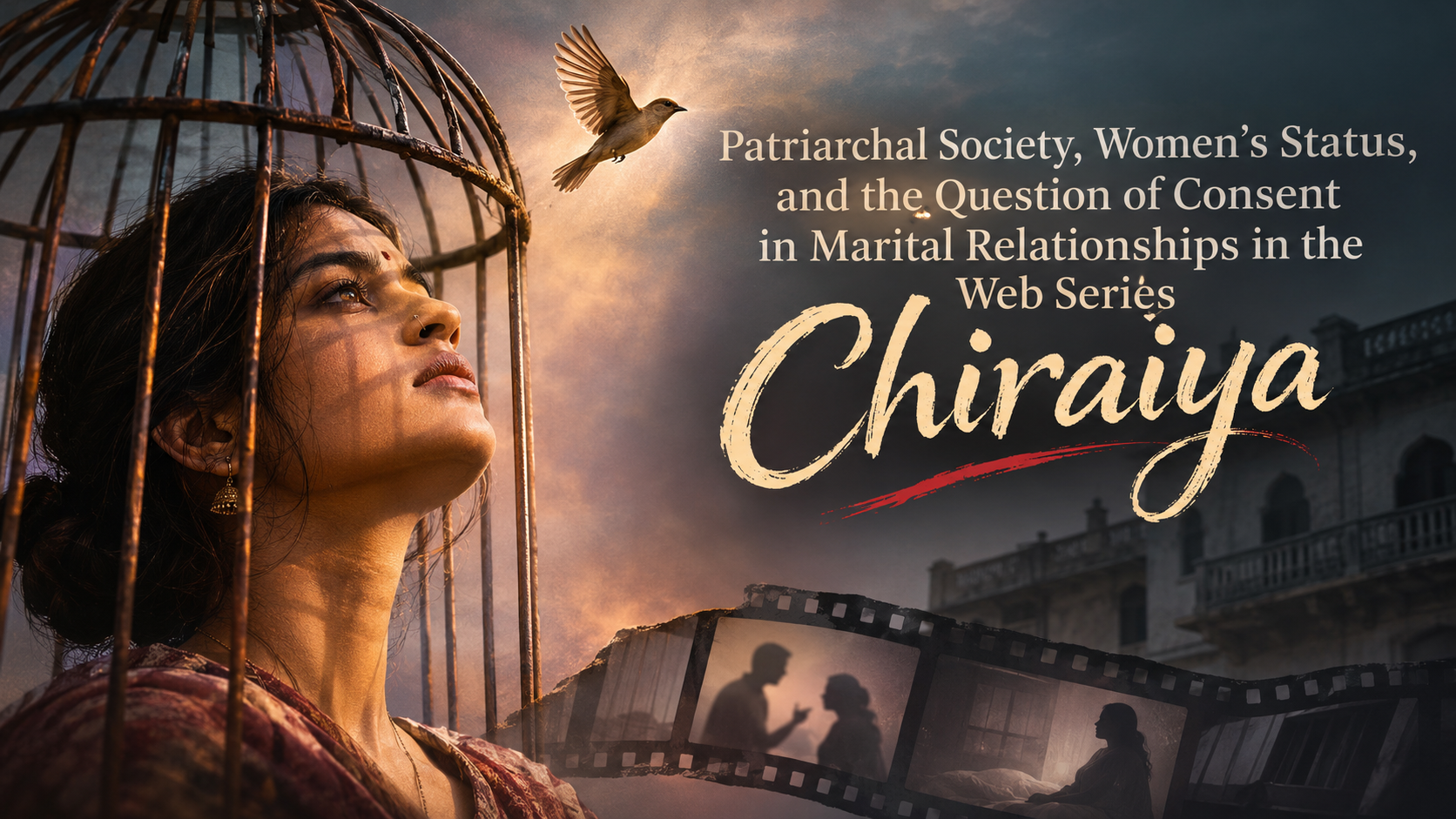
This research article critically examines patriarchal mindset, women's social status, and the question of consent in marital relationships through the web series Chiraiya. It explores how women's emotions, desires, personal decisions, and bodily autonomy are often suppressed within marriage. Through the characters of Kamlesh and Pooja, the study highlights gender inequality, social pressure, marital exploitation, and the fear of social defamation. It also examines how silence sustains patriarchal structures while courage, self-realization, and resistance become powerful expressions of women's
Patriarchal Society, Women's Status, and the Question of Consent in Marital Relationships in the Web Series Chiraiya
On March 20, 2026, the six-episode web series Chiraiya, directed by Shashank Shah and produced by Shrikant Mohata and Mahendra Soni, premiered on Hotstar. Its core theme is to bring to the forefront crucial questions such as the status of women, their struggle, and consent in marital relationships within Indian patriarchal society. This web series demonstrates that in our society, a man is often considered the ultimate decision-maker of the family and relationships, while a woman's desires, emotions, and personal choices are left behind.
The web series attempts to explain that marriage is not merely a social or legal bond, but rather the name of a relationship rooted in mutual respect, understanding, and consent between two people. However, due to patriarchal mindset, a woman's "no" is often not given importance, and the husband's authority is considered paramount. This very mindset forces a woman to endure mental, emotional, and social pressures.
The characters of the web series and their dialogues highlight very sensitively the fact that a woman is not restricted merely to familial responsibilities. Her own identity, desires, dreams, and rights are equally important. Here, Chiraiya emerges as a symbol—a symbol of a woman who, while living amidst restraints, searches for her existence, dignity, and a free flight.
Thus, Chiraiya no longer remains just a story; rather, it becomes a powerful voice raised against the suppression of female identity, gender inequality, the denial of consent in marital relationships, and the patriarchal system.
The Initial Form of OTT Platforms
In the twenty-first century, web series have established themselves as one of the most influential and widespread mediums of mass communication. The rapid expansion of digital technology and the internet has completely transformed the structure, presentation, and consumption nature of the entertainment industry. While traditional cinema and television depended on fixed times, locations, and mediums, web series have developed a new culture of entertainment by freeing viewers from the limitations of time and space. This is the reason why today web series are no longer merely a means of entertainment, but have become a powerful platform for social, cultural, and ideological discourse.
The primary reason for the popularity of web series is their easy availability, diversity of content, and material created according to the changing tastes of viewers. The increasing reach of the internet and the widespread use of smartphones have played an important role in bringing this medium to the general public. At present, the young generation is particularly attracted to digital platforms because here they get the freedom to choose content according to their preference and watch it at any time. In this context, it would be appropriate to say that web series have not only challenged traditional cinema, but on many levels have surpassed it to redefine the direction of the entertainment industry.
Digital platforms presenting web series and online audio-visual content are generally called OTT (Over The Top) platforms. OTT platforms are mediums that deliver content directly to viewers via the internet, eliminating the need for any traditional broadcasting system, such as a television network or cinema halls. Through these platforms, viewers can watch movies, web series, documentaries, news, music, live shows, interviews, and other audio-visual content at their convenience.
The most important feature of the OTT medium is its 'on-demand' nature, under which viewers can select content according to their convenience, interest, and time. Defining OTT, Anil Kokaram has written that:
"OTT refers to those media and entertainment services that are delivered directly to consumers through the internet."¹
In contemporary times, platforms like Netflix, Amazon Prime Video, Disney+ Hotstar, Sony LIV, and MX Player have attained a significant position in the global and Indian entertainment industry. These platforms not only provide diverse languages and cultures, but also provide expression to new themes, experimental plots, and social concerns. In his book Over the Top (OTT ka Mayajaal), Anant Vijay writes regarding the initial form of OTT platforms in India:
"Over The Top (O.T.T.) platforms are a relatively new medium of entertainment for our country. Since it has not been much time since this medium started in our country, various discussions continue to take place regarding this form of entertainment. Due to the increasing internet density and affordable data in the country, its reach has expanded. The nationwide lockdown during the Corona pandemic also made this medium popular; when people were confined to their homes and had no other means of entertainment besides television, these platforms came into people's preference. For two to two-and-a-half years, the threat of Corona kept audiences away from cinema halls, and due to the high prices of cinema tickets as well, audiences have now started waiting for films to release on O.T.T."²
The initial form of O.T.T. platforms in India existed earlier, but their widespread expansion becomes clearly visible after the year 2014. During this period, both foreign and Indian web platforms became active in the Indian market and, within a short span of time, began gaining immense popularity among viewers. Affordable internet, especially the expansion of 4G and 5G services, as well as the increasing accessibility of smartphones, further accelerated the growth of OTT.
The content of OTT platforms has established new dimensions for freedom of expression. While traditional cinema and television are controlled by limitations such as censorship, commercial pressures, and time constraints, creators on the OTT medium have gained relatively greater freedom. Due to limited censorship interference, creators are able to broadly explore topics that were considered sensitive or taboo for a long time, such as gender inequality, patriarchy, sexuality, mental health, and political critique. In this manner, it can be said that OTT platforms have not only transformed the nature of entertainment, but have also established new dimensions of social discourse.
In this very context, Chiraiya emerges as an important web series that sensitively presents the patriarchal system of Indian society and the position of women within it. This web series does not merely portray a woman's external struggles, but also effectively expresses the internal mental conflict, fear, insecurity, suppression, and questions related to self-respect going on within her. Through this, an attempt has been made to bring to light those experiences of a woman's life that are often ignored within the family and society. Furthermore, this work presents a serious social discourse on vital issues such as female identity, her independent identity, and equality and consent in marital relationships.
Patriarchal Society and the Status of Women in the Web Series Chiraiya
According to Simone de Beauvoir, a patriarchal society is a social system in which the male is considered superior, powerful, and the decision-maker, while the female is kept subordinate to him. In this system, a woman's identity is not determined as an independent individual, but rather in relation to the male. Simone de Beauvoir stated in her famous book The Second Sex:
"One is not born, but rather becomes, a woman."³
Similarly, Kamla Bhasin has discussed patriarchy in detail in her famous book What is Patriarchy?. She writes that:
"Patriarchy is a system in which men establish control over women's labor, body, sexuality, and decisions. Patriarchy is such a social system through which men receive power, property and the right to make decisions, while women are controlled."⁴
In the web series Chiraiya, a woman's life has also been presented like a bird trapped in a cage, where she wants to fly but cannot do so due to social restrictions, being controlled by the men of the house.
The title Chiraiya itself is a symbol that depicts the condition of a woman where her desires, dreams, and rights are restricted, which the main character of this series, Kamlesh, also expresses in her dialogue:
"Everyone likes a chiraiya (bird), but if a caged chiraiya starts to fly, the cage feels bad. Then, whether it means plucking its wings or breaking its nest, by doing whatever it takes, the chiraiya's flight is snatched away from it, just like ours was snatched away."⁵
It is clearly established in this web series how a patriarchal society controls a woman's decision-making capacity. From the choice of education to career and post-marital lifestyle, male dominance is visible at every level. Initially, Tauji's statement—"Aurat chahe toh duniya badal sakti hai" (If a woman wishes, she can change the world)⁶—gives an indication of his progressive thinking, but by the end of the narrative, the same Tauji, taking the side of his grandson Arun, becomes a representative of traditional patriarchal mentality. This transformation exposes the deep contradiction existing between society's professed ideals and actual behaviour.
Simone de Beauvoir, designating women as second-class citizens in her famous book The Second Sex, wrote that "Man is considered the 'primary' and woman the 'other' or secondary in society."⁷ This web series also portrays that in the social structure, a woman is often considered an existence of the secondary category.
This striking example comes to the fore when Kamlesh, while teaching Pooja to read the newspaper, says:
"Do you know where a woman's newspaper begins? From the back page. Today the government fell, clouds of crisis hovered over foreign nations, etc.—this is men's news; meaning, the front page is limited only to men. Whereas the back page, where 'how to make dhokla' is printed—the last page is read by women."⁸
This dialogue is not merely an ordinary statement; rather, it points towards women's restricted social role and their intellectual neglect. Thus, the web series unearths those subtle and deep aspects of the patriarchal system which show that a woman's progressiveness is merely a show. In the power structure of the house, male dominance has always been established, as Kamlesh says—"Papa ji is progressive, the house is not run by Papa ji, we run it."⁹ Women certainly run the house, but remain limited only to household chores. Even today, no matter how big decisions are made in the house, they are taken by men, even if that man is the woman's own son.
The gender division created between women and men in society is not limited only to social roles, behaviours, or rights; rather, it appears deeply embedded even in the most ordinary-seeming objects and habits of daily life. A small sequence presented in the web series Chiraiya reveals this fact very effectively. On the occasion of marriage, when the brother-in-law brings wine for his sister-in-law, and she says that water should not be mixed in it, Arun's remark—"This is women's wine, water is not mixed in it; men's wine is whiskey, in which water is mixed and consumed"¹⁰—points towards the gender stereotypes prevalent in society.
This dialogue appears ordinary at first glance, but beneath it lie deep layers of patriarchal thinking. Here, even an item of consumption like alcohol has been linked with the identities of women and men. "Women's" and "men's" division of alcohol shows that society determines not only individuals' behaviour, but also their preferences, consumption styles, and lifestyles on the basis of gender norms. Thus, femininity is associated with softness, lightness, and limited consumption, whereas masculinity is presented as a symbol of harshness, strength, and dominance.
This sequence of the series also highlights the fact that patriarchy is continuously reproduced not only in major social decisions, but also in everyday dialogues and ordinary behaviours. Such remarks unconsciously establish gender discrimination as normal and natural. As a result, the notion gets further strengthened in society that it is natural to have separate behaviours, preferences, and lifestyles designated for women and men.
The Question of Consent in Marital Life
The most important context of this web series is the question of consent in marital life. The incidents that happen with Pooja—being forced into the wedding night (suhaagrat) despite illness during and after the wedding, establishing physical relations with her even without her consent, and Arun's justification citing husband-wife status: "This is my legal right, I have only taken what is mine. I am your husband, this is my right"¹¹—all such dialogues depict the horror of marital rape.
"I am your husband, I am the one who did it, no outsider came to do it"¹²—these dialogues show that after marriage, regardless of the wife's willingness, the husband has complete authority over her body, whether she gives consent or not.
Pooja's mother Gayatri Awasthi's statement—
"You are married to him, you are a wife, all this has to be done, it happens with everyone, the question of 'no' does not arise at all, this is an unstated ritual... what 'no' does a wife have?"¹³
—highlights the fact that the patriarchal system is not operated solely by men, but often the women of the house themselves unknowingly become its carriers. A woman's silence and the fear of social defamation emerge as her biggest compulsion. A mindset like "what will people say" prevents a woman from resisting, and this very silence sustains her exploitation. In the web series, Kamlesh's statement—"A woman is not afraid of an atomic bomb, she is afraid of defamation"¹⁴—very effectively expresses women's social insecurity and reputation-centric fear.
Due to this very social pressure, Pooja, who was a victim of exploitation during her childhood tuition, starts hiding the truth from her mother because she is made to believe that speaking out will not bring a solution, but disgrace. As a result, her education is disrupted and mental agony eventually pushes her towards self-harm. As a consequence of continuous mental and physical torture by her husband, she reaches a deep psychological crisis and ultimately takes a self-destructive step such as harming her own genitals.
Despite this, instead of worrying about her emotional and physical condition, her husband is seen asking the doctor—"When can she resume physical relations again?"¹⁵ This sequence makes it clear that within the institution of marriage, a woman's body is often viewed not as her independent entity, but as the husband's property. Here, the distinction between sexual consent and property-ownership emerges very clearly. This discourse establishes the fact that marriage is not a synonym for permanent consent; a woman has the right to express her will and say "no" under every circumstance, which is also a central question of contemporary feminist thought.
Marital rape has still not received widespread social acceptance in Indian society. Calling the physical relations forced upon Pooja within marital relationships a "rape" immediately brings her face-to-face with taunts, derogatory remarks, and questions of morality. Statements like "Besharmo" (shameless) and "No outsider came" make it clear that even within the institution of marriage, a woman's consent is still considered secondary.
The prevailing notion in society is that after marriage, a woman's body and mind do not belong to herself, but her husband's authority is established over them. When physical relations will be established, what family planning will be like, or how many children there will be—the authority over these decisions mostly appears centralized in the hands of men, which the web series presents with extreme sensitivity.
Behind enduring this exploitation, various social and familial pressures remain at work, such as the pressure to maintain family prestige, the fear of social defamation, and expectations related to the future of other members of the family. Pooja also appears surrounded by these very pressures. An assurance of getting a job for her brother Tittu is given by her in-laws, due to which her parents also force her to return to her marital home after she leaves it. However, even after returning, no real change comes about in her circumstances, which makes it clear that the patriarchal structure is not merely personal, but deeply social and institutional.
In this very scene of the series, a poem presented by Kamlesh makes a deep satire on the traditional ideals and patriarchal expectations prescribed for women in Indian society. The lines of the poem—
"Jisse tute maryada aisa vyavhar na karna tu,
Tu banna Sita maiya, lekar rekha par na karna tu,
Phool nahi tu daag bane, tu keval meetha raag bane,
Krodh kabhi bhi aaye na tu, bas chuhe ki aag bane."¹⁶
—demonstrate that society today still considers decorum, sacrifice, and endurance as the ultimate ideals for a woman. Here, the 'Lakshman Rekha' (boundary line) does not remain merely a religious symbol, but rather takes the form of those social limits within which a woman is taught to restrict her behaviour, desires, and freedom.
"Phool nahi tu daag bane, tu keval meetha raag bane" highlights the fact that a woman is always expected to be soft, sweet-spoken, and enduring. She is not given the right to express her sorrow, dissent, or anger. Even lines like "Krodh kabhi bhi aaye na tu, bas chuhe ki aag bane" indicate that even if a woman experiences outrage or pain within, she should suppress it and re-engage in family and domestic responsibilities.
In this manner, this poem does not merely describe the so-called 'ideal form' of a woman, but makes a sharp satire on that societal mindset which, instead of accepting a woman as an independent individual, wants to limit her to sacrifice, endurance, and service. The poem raises the question of whether a woman truly possesses the equal right to express her feelings, voice her dissent, and make decisions for herself.
Arun's dialogue—"I have treated you with decency till today, I have never raised a hand"¹⁷—clearly exposes his patriarchal mindset. This statement is not merely a display of personal anger, but represents that social thinking in which a man considers himself to hold authority over a woman. Resistance or questioning by a woman appears to him as a challenge to his power. Through this sequence, the web series shows how deeply patriarchy is established in our society, where a woman's voice even today becomes a cause for discomfort and rejection.
A woman has always been deceived in the name of relationships, which Dadi (grandmother) keeps explaining to her two daughters-in-law through dialogue:
"Kamlesh, we have always been made fools—in the name of family, in the name of tradition, and in the name of who knows what, we have been systematically cheated, and we have been accepting it happily, for ages, for thousands of years, and we have been cheated even now, just like both of you have been cheated."¹⁸
However, within this very system, Kamlesh's character emerges as a powerful symbol of transformation and resistance. The rebellion of an ordinary housewife shakes the entire established structure of the house. Despite family opposition, her standing up in support of Pooja expresses the collective consciousness of women's struggle.
Dadi's statement—
"We don't have to break heads, Kamlesh, we just have to break the silence, just speak clearly in front of everyone. If a woman musters even this much courage, the person standing opposite will think a thousand times before laying a hand. Don't run away from home, fight while staying inside the home. Silence is society's weapon, and voice is a woman's. You cannot fight unarmed—you won't even be able to pierce through; you will have to pick up a weapon."¹⁹
—emerges as the central message of the entire web series. Here, silence is depicted as a medium of women's exploitation, and voice as a weapon of resistance. Dadi clarifies that in the name of tradition, love, and family, women have always been forced to remain silent, which made their exploitation possible.
Ultimately, Kamlesh highlights the contradiction between ideals and reality through historical and cultural examples, such as slokas like "Yatra naryastu poojyante, ramante tatra devata."²⁰ Her speech transforms personal pain into a broader social movement for women's rights and equality.
Ultimately, the web series Chiraiya brings to the forefront crucial questions such as the actual status of women in contemporary Indian society, their desires, their rights, and their consent in marital life with extreme sensitivity. This web series no longer remains just a story, but puts a question mark on those mindsets and traditions existing in society that have long suppressed women's freedom and emotions.
While emotionally engaging the viewers, the series also forces them to think about how many limitations and pressures women still have to face in decisions related to their own lives. At the same time, it also highlights the courage, self-realization, and spirit of resistance present within women. For this reason, Chiraiya emerges not merely as a medium of entertainment, but as an important and meaningful web series from the perspective of understanding women's discourse and contemporary Indian society.
References
- Anil Kokaram, Regis Crinon & Nicolas Catania, OTT (Over-The-Top) in 2015, SMPTE Motion Imaging Journal, 2015.
- Vijay, Anant. Over the Top: OTT ka Mayajaal. Prabhat Prakashan, 2023.
- Beauvoir, Simone de. The Second Sex. Trans. H. M. Parshley. New York: Vintage Books, 1989, p. 283.
- Kamla Bhasin, Kya Hai Pitrisatta (What Is Patriarchy?) New Delhi: Kali for Women, 1993.
Dialogue References
- Kamlesh speaking to herself – Chiraiya, Episode 6, "Katha", Director: Shashank Shah, JioCinema, Hotstar, March 20, 2026, Minutes [24:42–24:19].
- Kamlesh–Tauji dialogue – Chiraiya, Episode 1, "Griha Pravesh", Director: Shashank Shah, JioCinema, Hotstar, March 20, 2026, Minutes [29:52–29:49].
- 2010 English translation (Constance Borde & Sheila Malovany-Chevallier), Introduction, Page 6.
- Kamlesh–Pooja dialogue – Chiraiya, Episode 1, "Griha Pravesh", Director: Shashank Shah, JioCinema, Hotstar, March 20, 2026, Minutes [20:30–19:48].
- Kamlesh–Pooja dialogue – Chiraiya, Episode 1, "Griha Pravesh", Director: Shashank Shah, JioCinema, Hotstar, March 20, 2026, Minutes [18:05–18:00].
- Kamlesh–Arun dialogue – Chiraiya, Episode 1, "Griha Pravesh", Director: Shashank Shah, JioCinema, Hotstar, March 20, 2026, Minutes [10:00–9:50].
- Arun–Pooja dialogue – Chiraiya, Episode 2, "Pag Phera", Director: Shashank Shah, JioCinema, Hotstar, March 20, 2026, Minutes [25:24–25:08].
- Arun–Pooja dialogue – Chiraiya, Episode 2, "Pag Phera", Director: Shashank Shah, JioCinema, Hotstar, March 20, 2026, Minutes [24:48–24:40].
- Gayatri Awasthi–Pooja dialogue – Chiraiya, Episode 2, "Pag Phera", Director: Shashank Shah, JioCinema, Hotstar, March 20, 2026, Minutes [15:59–15:09].
- Kamlesh dialogue – Chiraiya, Episode 2, "Pag Phera", Director: Shashank Shah, JioCinema, Hotstar, March 20, 2026, Minutes [23:00–22:50].
- Arun speaking to the doctor – Chiraiya, Episode 4, "Chiraiya", Director: Shashank Shah, JioCinema, Hotstar, March 20, 2026, Minutes [20:11–20:05].
- Kamlesh dialogue – Chiraiya, Episode 5, "Vidai", Director: Shashank Shah, JioCinema, Hotstar, March 20, 2026, Minutes [20:25–19:56].
- Arun dialogue – Chiraiya, Episode 6, "Katha", Director: Shashank Shah, JioCinema, Hotstar, March 20, 2026, Minutes [09:27–09:16].
- Kamlesh–Pooja–Dadi dialogue – Chiraiya, Episode 6, "Katha", Director: Shashank Shah, JioCinema, Hotstar, March 20, 2026, Minutes [19:42–19:06].
- Kamlesh–Pooja–Dadi dialogue – Chiraiya, Episode 6, "Katha", Director: Shashank Shah, JioCinema, Hotstar, March 20, 2026, Minutes [18:38–17:30].
- Kamlesh's speech – Chiraiya, Episode 6, "Katha", Director: Shashank Shah, JioCinema, Hotstar, March 20, 2026, Minutes [15:24–15:18].