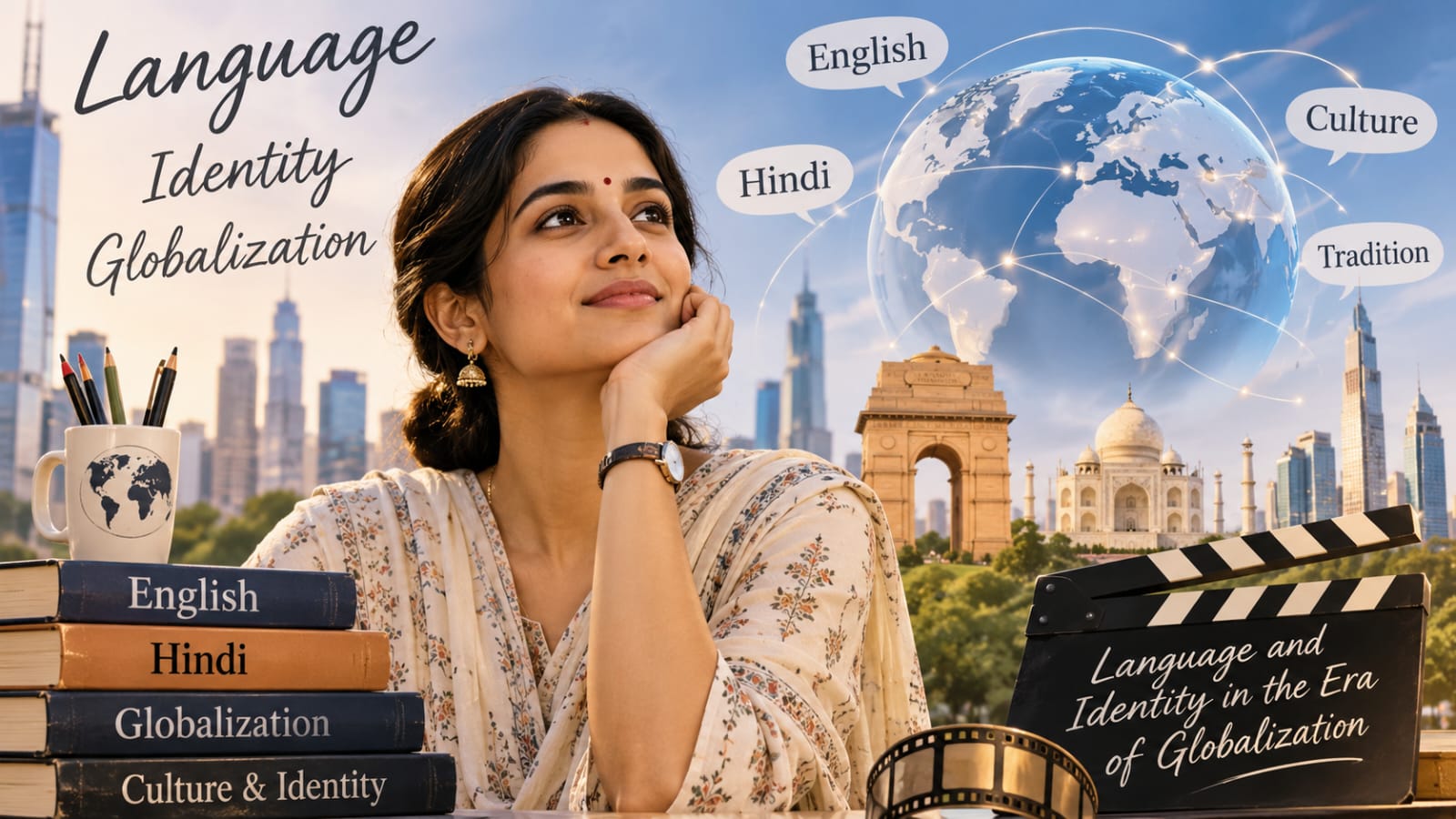
This research explores the relationship between language, identity, and self-respect in the era of globalization through the film English Vinglish. It examines how English influences social status, family relationships, women's identity, and individual confidence, while highlighting the importance of respecting every language and recognizing human dignity beyond linguistic ability.
Language and Identity in the Era of Globalization: With Special Reference to the Film English Vinglish
Abstract
In today's globalized society, language is not merely a means of exchanging ideas; it is also deeply connected with an individual's social identity, self-confidence, and dignity. Through the film English Vinglish, this study attempts to understand how language influences personal identity and how the importance of English has increased under the influence of globalization.The film's central character, Shashi, is an ordinary Indian homemaker who experiences neglect and discomfort within her family and society because she does not know English. Her experiences demonstrate that English is frequently associated with competence, modernity, and social prestige in contemporary society.
This research examines Shashi's journey towards self-reliance and demonstrates that language is connected not only with communication but also with an individual's self-esteem and confidence. The study also highlights the hierarchy that has developed between languages under globalization, in which English has acquired a privileged position.Despite this hierarchy, the film conveys the message that an individual's abilities and identity should not be judged solely on the basis of English proficiency. Every language carries its own cultural heritage and human experiences; therefore, all languages deserve equal respect.
Keywords: Globalization, Language, Identity, Self-respect, Cultural Identity, English Language, English Vinglish.
Introduction
The process of globalization has brought about significant changes in the nature of language and its social role. According to Anthony Giddens-
"Globalization is the process through which worldwide social relationships become more extensive and interconnected, increasing interdependence among countries and societies at economic, cultural, and social levels.Through this process, local life also becomes increasingly influenced by global developments and trends."¹
In contemporary society, English is no longer viewed merely as a language of communication. It has become an important form of cultural capital associated with social prestige, modernity, and opportunities. The film English Vinglish effectively presents the complex relationship between language and identity.
The protagonist, Shashi, is a capable, sensitive, and self-reliant homemaker. However, because she lacks proficiency in English, she does not receive the respect she deserves within her family and social environment. Her circumstances reveal how, under globalization, language has increasingly become a basis for social acceptance and the evaluation of an individual's identity. For Shashi, learning English is not simply a process of acquiring linguistic knowledge. It becomes a symbol of rebuilding her confidence, self-respect, and sense of identity. Her experiences suggest that although language inevitably influences a person's self-perception, it cannot define that person's entire identity.
The film emphasizes that an individual should be evaluated on the basis of personality, abilities, and human qualities rather than merely on linguistic competence. In this way, English Vinglish presents a meaningful discussion of globalization and the relationship between language and identity. It also raises an important question: Should knowledge of a particular language be the sole criterion for determining an individual's social standing?
The Journey of Hindi Cinema
"Hindi cinema cannot be viewed merely as an entertainment industry; it is also an important cultural record of Indian society, culture, language, and identity."²
Films have consistently reflected social emotions, conflicts, values, and changing ways of life.The history of Indian cinema is generally traced to Dadasaheb Phalke's Raja Harishchandra, released in 1913. Later, the release of Alam Ara in 1931 introduced sound and dialogue as new dimensions of Indian cinema. With the arrival of sound films, language, songs, music, and dialogue became integral components of cinema, allowing films to reach a wider audience.
During the freedom movement and the decades that followed, Hindi cinema portrayed the complex realities of Indian society. Rural life, social inequality, national consciousness, women's experiences, and human relationships became important themes.Films such as Do Bigha Zamin, Mother India, Pyaasa, and Bandini, particularly associated with the cinema of the 1950s and 1960s, presented social realities with sensitivity and artistic depth. Cinema consequently emerged as an important medium of social reflection and public awareness.
Following economic liberalization and the expansion of globalization, significant changes became visible in the themes, language, and cultural outlook of Hindi cinema. Global culture, consumerism, and the growing influence of English began to receive greater attention in films.As a result, questions relating to language, identity, and social relationships became increasingly important. Contemporary Hindi cinema explores cultural identity, linguistic confidence, and social acceptance in new ways.Films such as English Vinglish are particularly significant in this context because they demonstrate that language is not merely a means of communication; it is also an important factor in the construction of self-respect, social position, and identity.
Language, Self-Respect, and Identity in English Vinglish
Released on 5 October 2012 and directed by Gauri Shinde, English Vinglish presents the sensitive story of an ordinary Indian homemaker's struggle, self-respect, and recovery of self-confidence.The film begins with Shashi preparing laddoos. This immediately establishes her as a skilled, hardworking, and self-reliant woman who has transformed her domestic abilities into a small business. Despite these abilities, her family and society fail to give her the respect she deserves.
English is presented as a symbol of social prestige, modernity, and intellectual superiority. Shashi's inability to speak English becomes a source of ridicule for members of her own family.In the opening scenes, while speaking with her family at the breakfast table, Shashi mispronounces-
The English expression “jazz dance.”³
Her daughter and husband make fun of her. This incident is not simply an example of a linguistic mistake. It reveals a mindset in which a person's abilities and worth are judged according to their command of English.The repeated ridicule within the family damages Shashi's confidence and pushes her towards feelings of inferiority. However, her younger son and mother-in-law display a more sympathetic and supportive attitude towards her. Their behaviour reflects greater respect for her personality and labour.
The opening scenes therefore highlight the complex relationship between language, social prestige, and family relationships. The Relationship Between a Mother and DaughterThe communication gap between Shashi and her daughter, Sapna, provides an important example of how language influences family relationships.The distance between them does not arise simply from a lack of affection. Rather, it develops within a social environment in which English is treated as a standard of prestige and intellectual superiority. Sapna begins to consider her mother less capable because she cannot speak English fluently. In one scene, when Sapna goes out with her friends after telling her mother a lie, Shashi questions her normally upon her return. Sapna responds sarcastically by asking- > > "Will you teach English literature."⁴
This remark is more than a moment of irritation. It expresses a viewpoint in which knowledge, education, and intelligence are closely associated with English proficiency.The expression “English literature” functions as a sarcastic reference to Shashi's linguistic limitations. The incident reveals how language becomes a tool through which one person may be made to feel inferior to another.
The communication gap between mother and daughter also demonstrates how social values can influence the way younger generations evaluate their parents. Children may begin to judge their parents according to the same social standards that shape their own understanding of status and success.When Shashi's mother-in-law observes that children sometimes begin to underestimate their parents as they grow older, Shashi responds that children particularly underestimate their mothers. This statement highlights the broader social reality in which the labour, sacrifice, and experience of homemakers often remain invisible.A woman's linguistic or educational limitations are frequently treated as evidence of her overall inadequacy, even when she possesses considerable practical knowledge and ability.
Language and the Relationship Between Husband and Wife
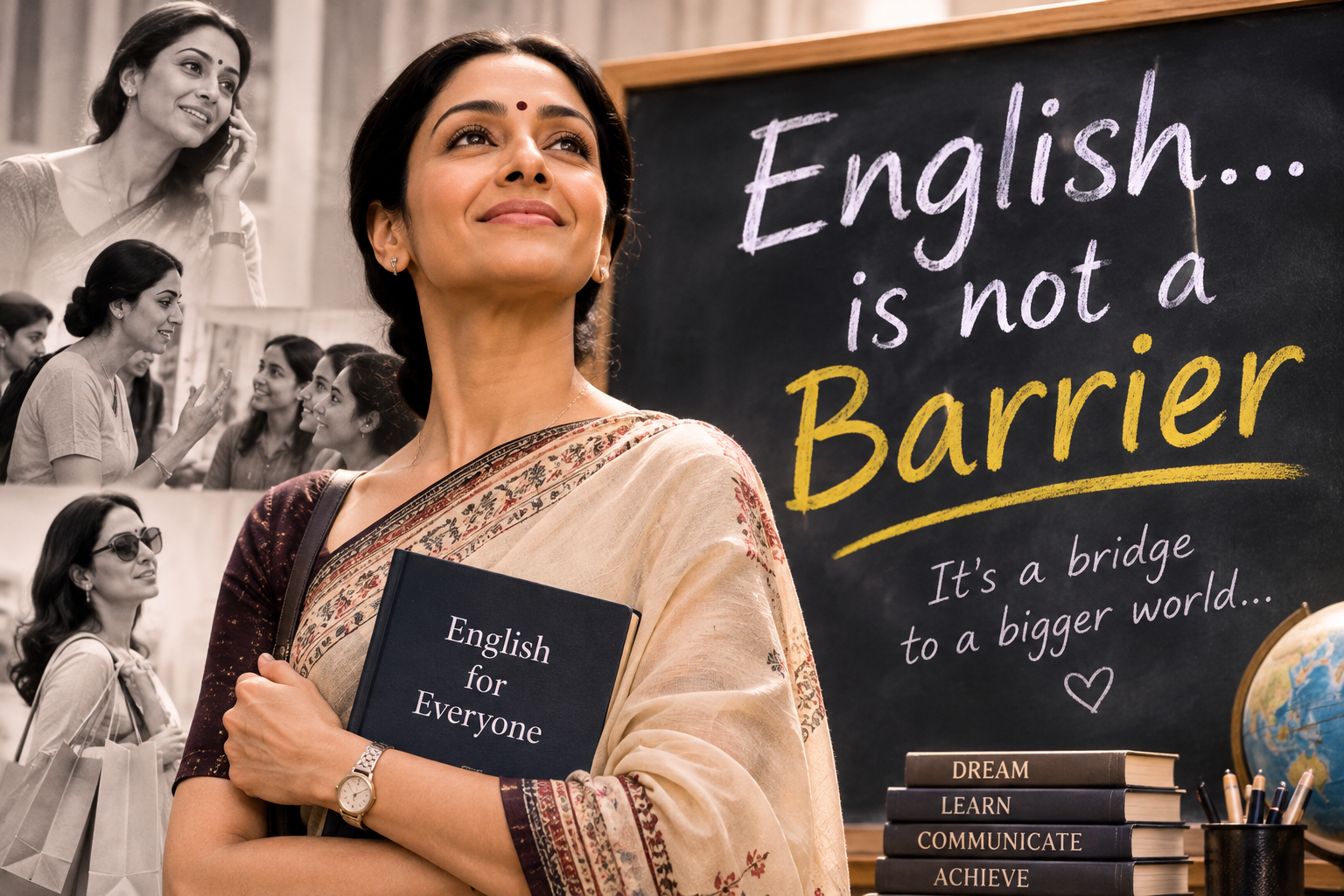
The communication gap is not confined to the relationship between Shashi and her daughter. It is also visible in her marriage.Shashi's husband, Satish, works for a multinational company where English is an essential part of the professional environment. Gradually, the linguistic difference between the couple creates emotional distance within their marriage.Shashi sometimes makes self-deprecating remarks:
"Why he to talk to her because she does not know English."⁵
Although these remarks may appear ordinary, they reveal the feelings of neglect, inequality, and emotional distance that have developed within the relationship.Language becomes a source of power. A person who knows English is often considered more capable or sophisticated, while someone who does not know it may be regarded as less intelligent or less worthy of respect.The parent-teacher meeting at Sapna's school further illustrates this mindset.Sapna feels uncomfortable about taking her mother with her because she fears that her mother's inability to speak English might embarrass her. When Shashi requests that the English literature teacher speak in Hindi, the teacher readily agrees that Hindi is their language and that there is no problem communicating in it.
The irony is that what the teacher accepts as entirely normal becomes a source of discomfort for Sapna. She feels that her mother has placed the teacher in an awkward position by admitting that she does not know English.This incident demonstrates how a section of the younger generation has come to view English not merely as a language but as a means of acquiring social prestige and recognition. Shashi's experiences gradually reinforce her awareness that:
"Her children have also begun to evaluate her identity according to these social standards."⁶
Emotional Distance Within Marriage
An important scene occurs when Satish warmly embraces a colleague. Shashi casually asks whether there is a special relationship between them.Satish replies that:
"It was simply a hug and a way of greeting someone, not an indication of any particularly close relationship."⁷
The exchange does more than highlight cultural differences. It also exposes the emotional distance between husband and wife.Shashi's question—
"why they never hug and whether their relationship is not close"⁸
This expresses years of accumulated neglect and emotional isolation.Her question reveals that she expects more from marriage than financial security or social acceptance. She also wants affection, respect, and emotional companionship. The scene suggests that the true closeness of a relationship cannot be established merely by living together. It develops through communication, respect, and the expression of emotions.The incident therefore represents a broader contradiction in modern family life: people may remain physically close while becoming emotionally distant.
Shashi's Experience in the United States
During an air journey, a character portrayed by Amitabh Bachchan attempts to help Shashi overcome her feelings of linguistic inferiority.He explains that travelling to a new place, especially visiting a foreign country for the first time, should not necessarily be a cause for fear or embarrassment. Instead-
"It can provide an opportunity to experience something new."⁹
His encouragement helps Shashi overcome some of her hesitation and enjoy the present moment.The scene conveys the message that language should not be the basis for evaluating a person's worth. Although the character speaks Hindi, he displays neither shame nor insecurity about his own language.Through this interaction, the film challenges the inferiority complex that can develop when English is treated as the ultimate measure of competence. It emphasizes the importance of self-acceptance and human dignity.
During her time in the United States, Shashi faces another difficult experience.At a café, she attempts to order coffee and a sandwich. Because she is unfamiliar with the language and struggles to communicate, she becomes nervous and accidentally drops someone else's food.The incident leaves her feeling publicly humiliated and embarrassed. Her emotional reaction demonstrates that the inability to communicate in an unfamiliar language can affect not only practical activities but also self-confidence and self-respect.However, the incident also reveals a positive aspect of human interaction. An unfamiliar person recognizes Shashi's difficulty, responds sympathetically, and brings her coffee.This gesture suggests that human relationships do not depend entirely on language. Sensitivity, understanding, and compassion can also establish meaningful connections between people.
Shashi's niece, Radha, also plays an important role in rebuilding her confidence. Rather than mocking Shashi's linguistic difficulties or considering her incapable, Radha continually encourages her and reassures her that she can learn a new language.Radha's attitude represents a more open, supportive, and compassionate perspective. She recognizes the potential within Shashi and motivates her to move forward with confidence.Her support demonstrates how family encouragement and human sensitivity can contribute to rebuilding an individual's self-confidence.
Gender, Domestic Labour, and Social Recognition
One of the film's important conversations concerns the different ways society values the work performed by men and women.When Laurent regards cooking as an art, Shashi points out that:
"If a man cooks, the activity is considered an art, whereas when a woman cooks, it is treated as her duty."¹⁰
This observation exposes the unequal standards applied to men's and women's work. The same activity may be regarded as creativity, talent, or professional expertise when performed by a man, while being considered an ordinary domestic responsibility when performed by a woman.As a result, women's labour often receives neither sufficient recognition nor appreciation.Shashi prepares food every day as a homemaker, yet her skills are rarely recognized as an art or a special accomplishment. If a male chef performs the same work professionally, however, it can bring prestige, respect, and professional recognition.The conversation therefore raises important questions about gender inequality, the social evaluation of labour, and women's identity.Through Shashi's experiences, the film demonstrates that the problem does not lie in women's abilities. Rather, it lies in a social perspective that treats women's contributions as ordinary while considering men's contributions exceptional.The film thus moves beyond a discussion of cooking and examines the wider relationship between women's identity, self-respect, and social recognition.
The Emotional Impact of Family Behaviour
Another important incident occurs when Shashi's daughter speaks disrespectfully to her about scrapbook and her-
Inability to read or understand it.¹¹
Shashi experiences deep emotional hurt. Her response demonstrates that repeated disrespect within a family can seriously affect a person's self-esteem.She points out that:
"Children are often considered innocent, but questions what kind of innocence allows them to hurt their parents repeatedly."¹²
Shashi challenges the tendency to excuse every action of children simply because they are young or inexperienced. Knowledge, language, and behaviour can be learned, but respecting another person's feelings and dignity requires sensitivity, empathy, and an understanding of human values.The incident demonstrates that the deepest hurt often occurs when one's own family fails to acknowledge one's feelings.The film presents Shashi's personal development as a struggle between her desire for self-improvement and the responsibilities imposed upon her by family life.Even after arriving in the United States, Shashi attempts to continue her English classes. However, the circumstances of family life make this difficult.
The film shows how a woman who attempts to make time for education, personal development, or an individual identity may find her efforts treated as neglect of family responsibilities.Consequently, she begins to experience guilt and considers abandoning her ambitions.Shashi's emotional struggle represents the experiences of many women who feel guilty even when they attempt to do something for themselves.
Radha's Role in Shashi's Transformation
Radha plays a positive role in Shashi's journey towards self-confidence.When Radha learns about her aunt's efforts to learn English, she supports her and encourages her to enjoy new experiences. Her behaviour reflects respect and appreciation for Shashi's efforts.
Radha recognizes Shashi's abilities rather than judging her according to her linguistic limitations. She understands that Shashi can learn a new language and develop greater confidence.Radha's support highlights the importance of encouragement and compassion in the process of personal development. The film also reveals the inequalities present within family relationships. When Shashi's daughter calls from India and speaks disrespectfully to her mother about Facebook, Shashi experiences another emotional setback.
Her daughter makes a remark suggesting that Shashi does not even know how to read. Shashi is deeply hurt by the comment, and her reaction demonstrates how persistent disrespect within the family affects her self-esteem.The incident also raises questions about the assumption that children can always be excused for their behaviour because of their age or lack of understanding.Shashi believes that language, knowledge, and skills can be learned, but respect for another person's feelings and dignity requires sensitivity and empathy.The film thus demonstrates that education and linguistic competence alone cannot guarantee emotional maturity or respectful behaviour.
Shashi's Journey Towards Self-Respect
As Shashi continues her journey of self-development, the tension between personal ambitions and family responsibilities becomes increasingly visible.When she tries to continue her English classes despite her domestic obligations, her efforts are not always appreciated. Instead, her family sometimes interprets her desire for personal growth as neglect of her responsibilities.Hurt by Satish's remarks, Shashi begins to see herself as a selfish mother and wife. She considers giving up her efforts to learn English.
This situation demonstrates how patriarchal social structures can make women feel guilty for pursuing education, personal growth, or an identity beyond domestic responsibilities.Shashi's struggle is therefore not merely about learning English. It is also about overcoming the social and emotional barriers that prevent women from recognizing their own worth.The film represents the experiences of countless women who sacrifice their ambitions because they feel responsible for maintaining family harmony.
At the same time, the appreciation Shashi receives for the laddoos she prepares reveals the limitations of the recognition available to her. When everyone praises her laddoos, Satish remarks that:
"His wife was born to make laddoos."¹³
Although the statement may appear to be humorous or complimentary, it contains a deeper gender bias. It reduces Shashi's entire identity to her domestic skills and overlooks her intelligence, talents, ambitions, and desire for personal development.The scene demonstrates how women's achievements are often praised only within the boundaries of traditional domestic roles, while their broader intellectual abilities and aspirations remain unrecognized.Satish's remark therefore raises questions about women's self-respect, identity, and social acceptance.
The Importance of Recognition and Respect
Towards the end of the film, Shashi expresses the central emotional concern of her journey in the statement that:
"She does not need love alone; she also needs respect."
This statement captures the central message of the film.Love and affection are important in personal relationships, but they are not sufficient when an individual's abilities, feelings, and identity are repeatedly dismissed.Shashi receives affection from her family, yet she does not receive the respect she deserves. Her inability to speak English leads others to underestimate her, disregard her opinions, and fail to recognize her domestic skills.
Her statement points towards a broader social reality in which women's worth is frequently judged according to linguistic ability, educational qualifications, or social presentation.Although Shashi is loved by her family, she does not receive the recognition she believes she deserves.The film emphasizes that affection must be accompanied by respect for a person's abilities, dignity, and identity.Shashi's journey towards confidence reaches its culmination when she successfully speaks English at a family wedding.
After completing four weeks of English classes, she is expected to take an examination. However, because of family circumstances, she is unable to attend the examination centre.Despite this setback, Radha, who has supported Shashi's efforts from the beginning, arranges for Shashi's English teacher to attend the wedding. Shashi herself is unaware of the arrangement.During the wedding, when people are expressing their thoughts, Shashi delivers a speech in English. Her natural and effective expression surprises everyone present.Her husband and daughter, who had previously underestimated her because of her English, are astonished to see her speaking confidently.This moment represents more than the achievement of learning a language. It symbolizes the recovery of Shashi's self-confidence and self-respect. Her success demonstrates that personal development is possible when individuals receive encouragement and are given opportunities to recognize their own abilities.
The Film's Final Message: Identity Beyond Language
Near the end of the film, Shashi's son tells his sister that:
"She should think before speaking English in front of their mother because their mother may speak English better than she does."¹⁵
This statement suggests that Shashi's son is one of the family members who has shown the least prejudice towards her.Unlike the other family members who previously mocked Shashi's linguistic limitations, he does not ridicule her. His behaviour highlights the importance of respect and understanding within the family. By this point, the people who once considered Shashi inferior because of her English are surprised by her transformation. Her journey challenges their earlier assumptions about her abilities and intelligence.The film establishes that an individual's worth should not be determined by knowledge of a particular language. Rather, it should be recognized through personality, competence, and self-confidence.In the final part of the film, Shashi thanks Laurent and expresses an important reflection:
"when people do not love themselves, life begins to feel burdensome and dull. When they overcome their weaknesses and learn to accept themselves, even their familiar lives can begin to feel new and beautiful.Her words express the profound personal transformation she has experienced."¹⁶

Laurent appears not merely as a friend but as someone who helps Shashi recognize her abilities and develop confidence in herself. Their relationship is presented primarily through the human support that contributes to Shashi's journey of self-acceptance.The film therefore presents Shashi's story not simply as a narrative about learning English, but as a journey towards self-respect, self-acceptance, and personal identity.
Conclusion
English Vinglish effectively presents the complex relationship between language, identity, and self-respect in the era of globalization.
The film demonstrates that English has become an important medium of social prestige, but an individual's true identity cannot be determined solely by linguistic knowledge.
Shashi's journey represents the recovery of self-confidence, self-acceptance, and dignity. Through her experiences, the film raises important questions about linguistic inequality in contemporary society.
It also highlights the unequal social valuation of women's work and the tendency to confine women's identities to domestic responsibilities.
The film shows that a woman's contribution is often treated as ordinary when it concerns household work, while similar work performed by men may be recognized as a talent or profession.
In this way, the film connects questions of language and identity with wider issues of gender inequality, domestic labour, and social recognition.
Ultimately, English Vinglish conveys the message that although English has become an important marker of social prestige, it should not be used as the sole criterion for evaluating an individual's identity.
Shashi's journey is a journey towards the recovery of confidence, self-acceptance, and respect. Through her experiences, the film raises important questions about linguistic inequality and the social values that shape personal identity in contemporary society.
The film reminds us that language can influence the way people see themselves and are treated by others, but a person's true worth extends far beyond their linguistic abilities.
References
-
Giddens, Anthony. The Consequences of Modernity. Cambridge: Polity Press, 1990, p. 64.
-
Rajadhyaksha and Willemen, reference cited in the original article. Full bibliographic details should be verified against the original source.
-
Shashi–Sapna conversation, English Vinglish, approximately 07:00–07:07.
-
Shashi–Sapna conversation, English Vinglish, approximately 08:02–08:48.
-
Shashi–Satish conversation, English Vinglish, approximately 10:00–10:14.
-
Shashi's conversation with her mother-in-law, English Vinglish, approximately 16:35–16:56.
-
Shashi–Satish conversation, English Vinglish, approximately 22:39–22:49.
-
Shashi–Satish conversation, English Vinglish, approximately 22:50–22:56.
-
Amitabh Bachchan's character speaks to Shashi during the flight, English Vinglish, approximately 31:41–31:57.
-
Shashi–Laurent conversation, English Vinglish, approximately 1:03:56–1:04:45.
-
Sapna's conversation with Shashi, English Vinglish, approximately 1:10:56–1:11:24.
-
Shashi–Laurent conversation, English Vinglish, approximately 1:12:02–1:12:50.
-
Satish's conversation, English Vinglish, approximately 1:41:41–1:42:04.
-
Shashi–Radha conversation, English Vinglish, approximately 1:45:55–1:46:17.
-
Sagar's conversation with Sapna, English Vinglish, approximately 2:01:36–2:01:45.
-
Shashi–Laurent conversation, English Vinglish, approximately 2:02:19–2:03:10.