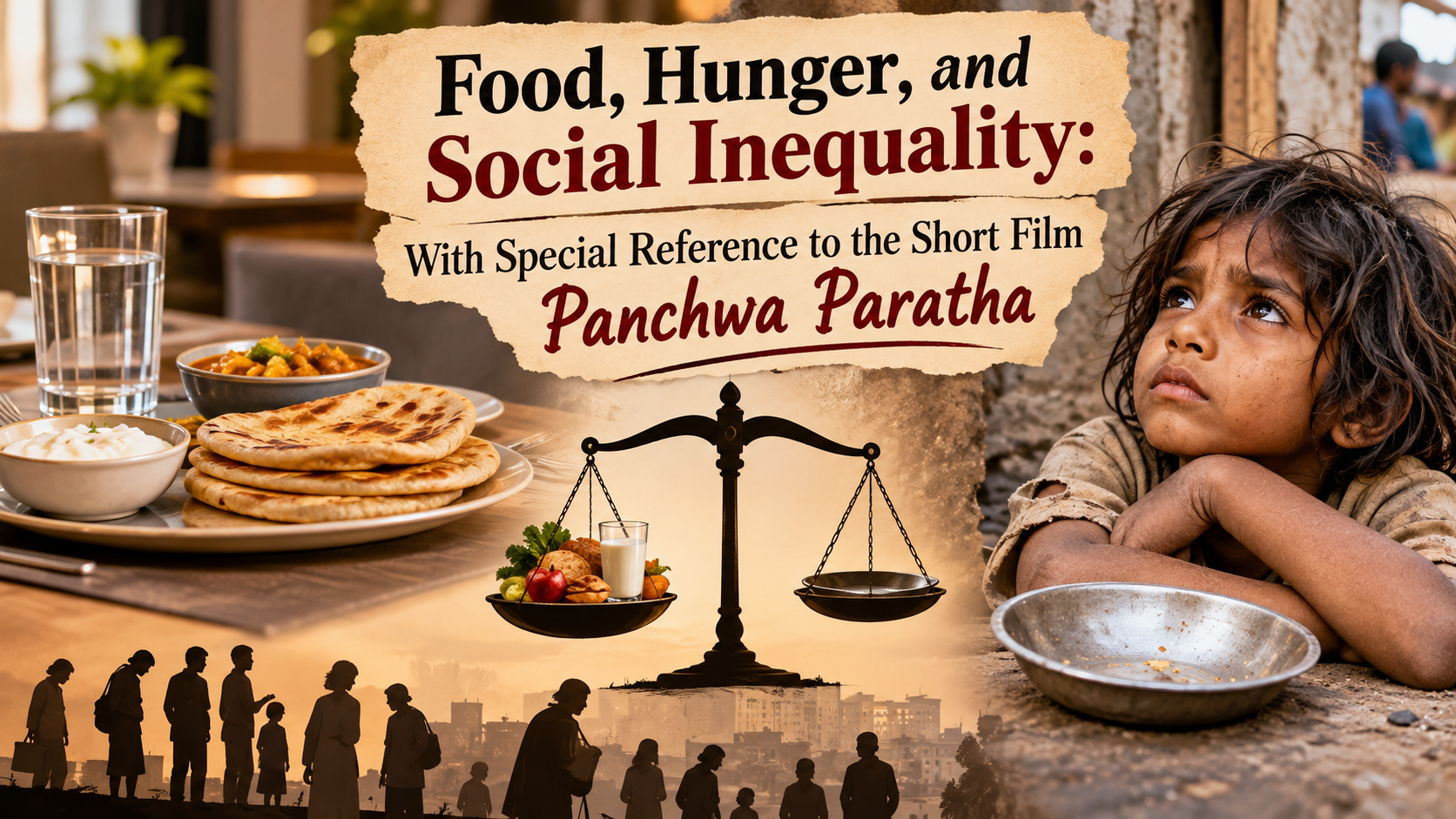
The short film Panchwa Paratha explores the realities of hunger, food insecurity and social inequality through an ordinary yet deeply meaningful narrative. It reveals how food, beyond being a basic necessity, often reflects the economic conditions and social privileges of individuals. While a meal may be an everyday comfort for some, it remains an uncertain struggle for many others. Through its sensitive portrayal, the film draws attention to class divisions, unequal access to resources and the gradual loss of human empathy.
Food, Hunger, and Social Inequality: With Special Reference to the Short Film Panchwa Paratha
Abstract
This research paper, titled “Food, Hunger, and Social Inequality: With Special Reference to the Short Film The Panchwa Paratha,” analyses the economic disparities prevalent in society, the problem of hunger, and the unequal distribution of resources.The Panchwa Paratha is a moving short film that uses an everyday necessity—food—to reveal class divisions and human suffering. By placing an apparently ordinary paratha at the centre of its narrative, the film demonstrates how the meaning and importance of food differ among various social classes. For the affluent, food is an ordinary item of consumption; for the disadvantaged, it becomes a question of survival and existence.
This study adopts a qualitative research methodology and analyses the film's narrative, characters, dialogues, and symbols. The research demonstrates that hunger is not merely a matter of physical necessity but is also connected to social justice, human dignity, and equal opportunities.The film suggests that economic inequality affects not only people's income but also their lives, opportunities, and self-respect.
Keywords: Hunger, social inequality, economic disparity, class divisions, human emotions, food, social justice, short film, disadvantaged classes, dignity.
Introduction to the Short Film
Short films are an important form of cinema that present an idea, problem, experience, or emotion effectively within a limited period. Generally, films lasting approximately 40 minutes or less are classified as short films.¹ The purpose of a short film is not limited to entertainment. It can also encourage reflection on social, cultural, and human concerns. Its greatest strength lies in its ability to communicate a profound message and leave a lasting impression within a short duration.
The history of short films is almost as old as the history of cinema itself. During the early years of cinema, most films were short because of technological limitations. Workers Leaving the Lumière Factory, shown by the Lumière brothers in France in 1895, is regarded as one of the earliest films in the history of world cinema.² Early films lasted only a few seconds or minutes because of the technical limitations of the period.Even after the development of feature-length, narrative-driven films, short films retained their independent identity. Today, they have become a powerful medium for social awareness, alternative expression, and creative experimentation.
The film historian Pamela Hutchinson has described the Lumière brothers' films as more than technological inventions, viewing them as artistic expressions that captured subtle moments of human life.³ Early short films presented ordinary events from everyday life with remarkable sensitivity. This quality continues to be visible in contemporary short films. Within this tradition, The Panchwa Paratha emerges as a significant short film. It explores serious issues such as food, hunger, and social inequality through a simple yet powerful narrative.
In the film, the paratha is not merely a symbol of food. It also represents the unequal distribution of resources, opportunities, and social privileges.For some people, food is an ordinary necessity available every day. For many others, obtaining enough food remains a constant struggle for survival.Through its brief but powerful narrative, The Fifth Paratha makes viewers more sensitive to hunger, poverty, and social inequality. It encourages them to reconsider questions of social justice and human equality.
The Panchwa Paratha and Social Inequality
Social inequality refers to the unequal distribution of resources, opportunities, prestige, and power within society.According to the renowned sociologist Anthony Giddens:
"social inequality exists when resources and opportunities are distributed unequally among different groups within society".⁴
Social inequality is not restricted to differences in income. It can also be observed in education, healthcare, food, housing, caste, class, and gender. The availability of food and the experience of hunger are particularly important dimensions of social inequality because not everyone has equal access to essential nutritional resources.In this context, The Panchwa Paratha presents a social reality in which different forms of inequality become visible through the experiences of hunger and food insecurity.
The film demonstrates that food is not simply a biological necessity. It is also an important indicator of social and economic inequality.Directed by Sanjay Gupta, the short film begins by revealing the tragedy of hunger and deprivation through the experiences of a young girl named Bitti and her family.The opening scene shows Bitti facing taunts from a friend at school. Her friend says:
“You should bring food too sometime. Are we supposed to feed you every day?”⁵
This dialogue is not merely an ordinary conversation between children. It reveals the humiliation and feelings of inferiority that can arise from economic inequality.An apparently small act, such as sharing food for one day, can become a source of humiliation for someone who is unable to afford it.
The film presents this situation with considerable sensitivity, demonstrating how poverty can affect a person's dignity and self-esteem.The film is set against the background of industrial unrest in Kanpur during the 1970s, when many working-class families experienced unemployment and severe food shortages.
The effects of this social and economic crisis are also visible in Bitti's family. After returning home from school, humiliated and distressed, Bitti begins searching through the utensils in the house, hoping to find something to eat. However, she cannot find any food.This scene is not merely a moment of disappointment in a young girl's life. It represents the collective suffering of a social class for whom even a basic necessity such as food has become difficult to obtain.
Unable to bear the pain of hunger, Bitti tells her mother:
“When I'm hungry, my stomach hurts and cramps. I can't even study because of the hunger.”⁶
This statement is particularly significant because hunger is no longer presented as merely a physical discomfort. It becomes an obstacle to education and future opportunities.The film emphasises that when people's basic needs remain unmet, their ability to learn, develop, and improve their lives is also affected.In a moment of anger, Bitti also expresses her frustration with her father, saying:
“Everyone gets a job except him. He spends the whole day lying around at home, sleeping. He's lazy and idle.”⁷
This dialogue reflects a child's helpless reaction to circumstances she cannot fully understand.In reality, her father's unemployment is not necessarily the result of personal failure. It is connected to the wider economic crisis created by industrial unrest and instability.
However, a child distressed by hunger cannot easily understand these structural causes. She experiences the immediate consequences of poverty and directs her frustration towards the people closest to her.The film thereby demonstrates how economic inequality can create emotional distress within families.
Bitti's mother attempts to comfort her daughter, but her circumstances leave her with few options. Her suffering reflects the position of countless families who struggle to meet their basic needs despite their efforts.The film's opening sequence thus establishes hunger, deprivation, and social inequality as the central concerns of the narrative.
Hunger, Human Dignity, and the Struggle for Survival
One of the most emotionally powerful moments in the film occurs when Bitti's mother slaps her. Even after this, Bitti's words deeply disturb the viewer.She says:
“You can beat me with shoes or even beat me to death, but please give me one roti before I go to school.”⁸
This dialogue is among the film's most moving moments.
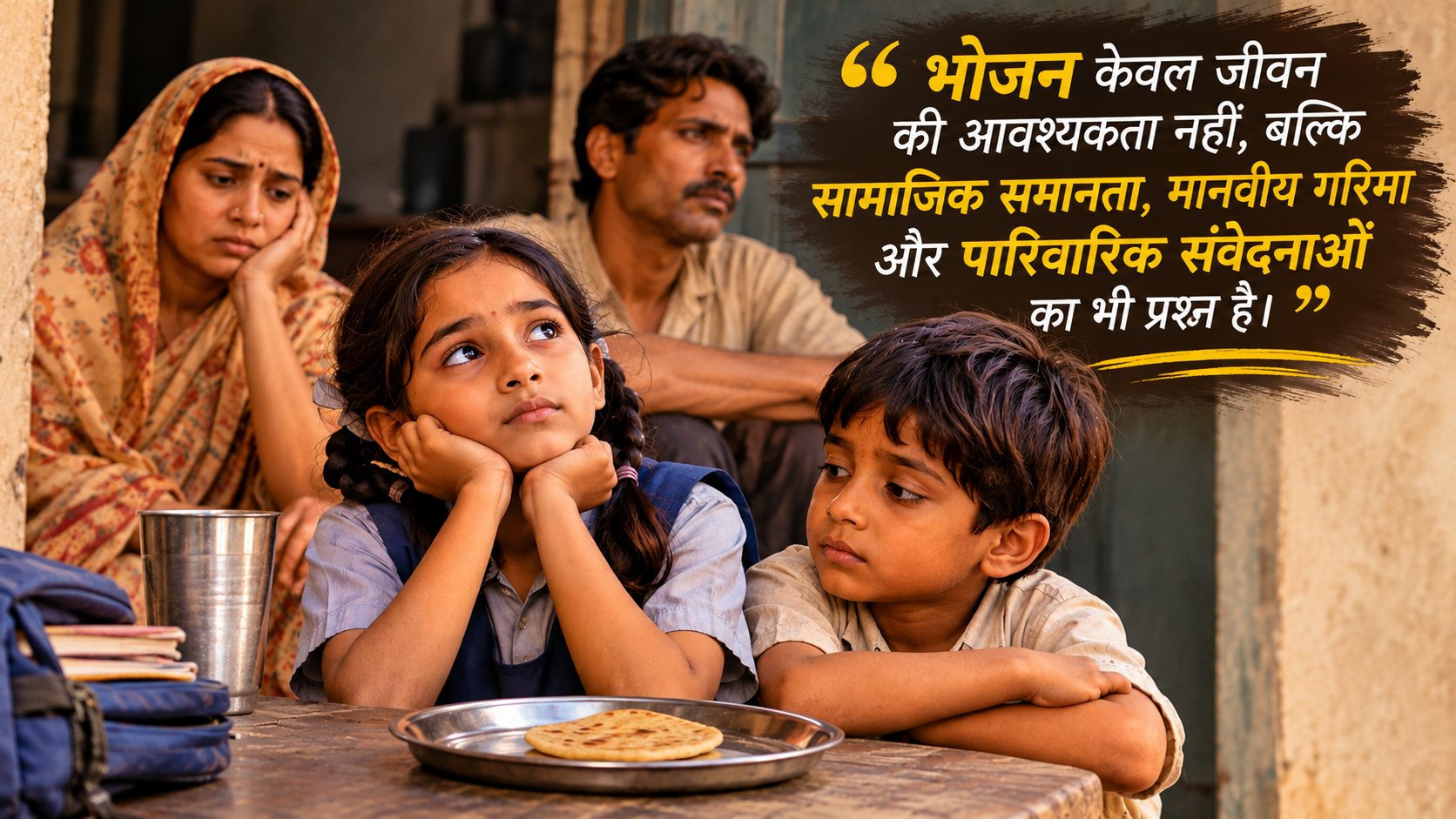
A child asking for food is not demanding luxury or comfort. She is asking for the minimum necessary to survive.Her words reveal a social reality in which hunger has become so severe that a child is willing to endure physical punishment in exchange for food.Hunger affects not only the body but also human dignity, education, relationships, and emotional well-being.
The film demonstrates how the absence of a basic necessity can undermine a person's ability to participate fully in social life.When Bitti's father returns home and learns that his daughter has been beaten, he asks his wife why she struck the child.Her mother explains, in a distressed voice, that Bitti was agitated because she was hungry. Bitti's father takes his daughter's side and says:
“She's a child. Of course she'll feel hungry; she spends the whole day going back and forth at school.”⁹
This dialogue reflects both a father's compassion and his helplessness. He understands his daughter's suffering but is unable to provide her with the food she needs.His wife responds:
“How can I feed four people on my own?”¹⁰
Her words reveal the economic reality of a family whose needs exceed its limited income.The film shows that poverty is not simply a lack of material resources. It also creates continuous psychological stress and insecurity.The family must constantly calculate how to divide its limited resources among its members. Even small decisions about food become difficult because every expenditure affects the family's ability to survive.When Bitti's mother asks her husband whether he has brought anything home, he gives a painful response:
“Everyone is eager to make us work, but when it comes to paying us, they keep putting it off.”¹¹
This dialogue highlights the exploitation of the working class and the problem of insecure employment.Although workers' labour is essential to society, their rights and fair compensation are frequently neglected. In the midst of this helplessness, Bitti's father takes out a little jaggery from his pocket. He explains that he obtained it on credit from a shopkeeper and asks his wife to prepare a jaggery drink.This scene presents a vivid picture of the family's poverty. A simple drink made with jaggery becomes the only available means of temporarily relieving the family's hunger.
The narrative then moves beyond immediate hunger and introduces concerns about the children's future.Bitti's mother says:
“Bitti will eventually leave after getting married. Bittu will be the one to support us in our old age, so we must enrol him in school now.”¹²
This statement reflects the thinking prevalent in many lower-income Indian families, where education is viewed as a means of securing a better future and achieving social mobility.Despite financial hardship, parents continue to dream of a better life for their children.The night-time scene gives the film greater emotional depth. Husband and wife discuss their poverty and their children's future.The father says:
If we have brought children into this world, then surely we must feed them too. What fault is it of theirs?”¹³
This dialogue expresses the parents' sense of moral responsibility and compassion towards their children.Despite their difficult circumstances, they do not blame the children for their needs. Instead, they recognise their own responsibility to provide for them.The mother's response reveals her suffering even more painfully. She says:
“If I were alone, I could somehow endure it. And if God has given us children, surely He would also provide the means to feed them. What kind of parents are we if we cannot even give our children one meal a day?”¹⁴
These words are a deeply moving expression of maternal guilt, helplessness, and love.Her suffering is not merely the result of poverty. It also comes from the feeling that she is failing to protect her children from hunger.After hearing these words, the father falls silent. His silence carries profound meaning.Unable to bear the family's suffering, he goes out into the freezing cold to work as a security guard.This scene reveals the often-invisible struggle of working-class parents who are forced to labour under difficult conditions to provide food for their children. The film shows that the struggle against hunger frequently requires parents to sacrifice their own comfort, rest, and well-being.
The Paratha as a Symbol of Hope and Inequality The following day, Bitti's mother receives ten rupees.Under ordinary circumstances, one might expect her to use the money to purchase enough flour to feed the family for several days.However, she firmly expresses her desire to make parathas.Her husband is surprised because he knows that preparing parathas that day would consume all ten rupees at once.This scene clearly demonstrates how the same object can have very different meanings for different social classes.For an affluent family, a paratha may be an ordinary part of a daily meal. For an economically deprived family, it can represent a rare opportunity and a moment of happiness.Bitti's mother's determination to make parathas is not simply a desire for something tasty. It represents her longing to experience a small celebration after a long period of deprivation. The emotional significance of this moment becomes even greater when the children hear that parathas are being prepared.Bittu excitedly says:
“I'll go and tell everyone that we've made parathas at our house today!”¹⁵
His excitement shows that something considered ordinary by one section of society can become a source of extraordinary happiness for another. The film therefore demonstrates that economic inequality affects not only access to resources but also people's desires, aspirations, and experiences of happiness.When Bittu asks for another paratha, his mother explains:
If you eat too many parathas, you'll start having trouble going to the toilet. Parathas made from wheat flour require a strong stomach. You'll get only two.”¹⁶
At first glance, this may sound like an ordinary mother's advice. In reality, it conceals the helplessness of a family living in poverty.The number of parathas is predetermined because the family cannot afford to provide more. Their limited food supply turns even the act of eating into a matter of strict calculation. Later, when Bitti sees the flour her mother has saved, she insists that another paratha should be made.
Her mother replies:
“Not now. We'll eat in the morning.”¹⁷» She then adds: «You're not old enough yet for us to send you to school without breakfast. Getting two meals a day is enough for us.”¹⁸
These statements reveal a social reality in which even breakfast can become a luxury.The film contrasts two different experiences of food. One group of people takes the availability of food for granted, while another struggles continuously to arrange two meals a day.Through this contrast, the film highlights the unequal distribution of basic resources in society.The most tragic turning point occurs when Bitti saves a paratha for herself and keeps it aside for the following day.
For Bitti, the paratha represents more than food. It symbolises self-respect, hope, and the possibility of avoiding further humiliation at school.However, the next morning, she discovers that her younger brother, Bittu, has eaten it. Angry and distressed, she shakes him and repeatedly asks: > “Did you eat my paratha? Did you eat my paratha?”¹⁹ Bittu innocently replies:
“Didi, I was hungry.”²⁰
This becomes one of the most heartbreaking moments in the film. Hunger places the two children in opposition to one another.Bitti has been so deeply affected by the humiliation she experienced at school that she can no longer fully understand her brother's helplessness. Her anger, rooted in her own suffering, becomes directed at him.
In her rage, she strangles her brother, causing his death. This tragic ending is highly symbolic and thought-provoking.The death of Bittu is not simply an individual tragedy. It exposes the devastating consequences of hunger and deprivation.The title The Panchwa Paratha becomes especially significant in this context. The paratha represents a basic human need that should never have become a source of conflict within a family.When society fails to provide its citizens with the necessities of life, hunger can destroy not only physical health but also human relationships, emotional bonds, and family affection.The ending forces viewers to confront the consequences of a social system in which access to food remains unequal.The tragedy demonstrates how prolonged deprivation can produce suffering that extends far beyond physical discomfort.It can damage education, dignity, emotional well-being, and even the bonds between family members.
Conclusion
The short film The Panchwa Paratha presents the tragedy of hunger, poverty, and social inequality with remarkable sensitivity. It demonstrates that the absence of food, a basic human necessity, causes not only physical suffering but also damages human relationships, education, emotions, and fundamental values.Through the experiences of Bitti and her family, the film exposes the difficult realities faced by economically disadvantaged people.It also shows how poverty can influence the aspirations, choices, and happiness of individuals.The paratha, which appears to be an ordinary food item, becomes a powerful symbol of unequal access to resources and opportunities.For affluent families, food may be an everyday necessity that is readily available. For families living in poverty, even a single meal can become a source of struggle, hope, and emotional distress.
Ultimately, The Panchwa Paratha encourages viewers to think seriously about social inequality, poverty, and food insecurity.The film's central message is that hunger is not merely a physical problem. It is also a social issue that concerns human dignity, equal opportunities, and justice.By presenting these issues through an emotionally powerful narrative, the film reminds society of its responsibility to ensure that every individual has access to the basic necessities of life.
References
-
Academy of Motion Picture Arts and Sciences. (n.d.). Rules for Short Film Categories.
-
Encyclopaedia Britannica. (n.d.). History of Film: Edison and the Lumière Brothers.
-
A Window on Infinity: Rediscovering the Short Films of the Lumière Brothers. The Guardian, 2016.
-
Giddens, Anthony. Sociology. 7th edition. Cambridge: Polity Press, 2013.
-
Dialogue at school. The Panchwa Paratha, 2024. Timestamp: 00:36–00:40.
-
Daughter speaking to her mother. The Panchwa Paratha, 2024. Timestamp: 03:02–03:10.
-
Daughter speaking to her mother. The Panchwa Paratha, 2024. Timestamp: 03:18–03:29.
8. Daughter speaking to her mother. The Panchwa Paratha, 2024. Timestamp: 03:32–03:38.
-
Husband supporting his daughter. The Panchwa Paratha, 2024. Timestamp: 04:40–04:40.
-
Wife speaking to her husband. The Panchwa Paratha, 2024. Timestamp: 04:40–04:42.
-
Wife speaking to her husband. The Panchwa Paratha, 2024. Timestamp: 05:00–05:07.
-
Wife speaking to her husband. The Panchwa Paratha, 2024. Timestamp: 05:53–06:02.
-
Husband speaking to his wife. The Panchwa Paratha, 2024. Timestamp: 07:08–07:13.
-
Wife speaking to her husband. The Panchwa Paratha, 2024. Timestamp: 07:15–07:50.
-
Son speaking happily to his mother. The Panchwa Paratha, 2024. Timestamp: 11:46–11:50.
-
Mother speaking to her son. The Panchwa Paratha, 2024. Timestamp: 14:42–14:57.
-
Daughter speaking to her mother. The Panchwa Paratha, 2024. Timestamp: 18:08–18:10.
-
Mother speaking to her daughter. The Panchwa Paratha, 2024. Timestamp: 18:20–18:22.
-
Sister speaking to her brother. The Panchwa Paratha, 2024. Timestamp: 22:20–22:30.
-
Brother speaking to his sister. The Panchwa Paratha, 2024. Timestamp: 22:30–22:53.