
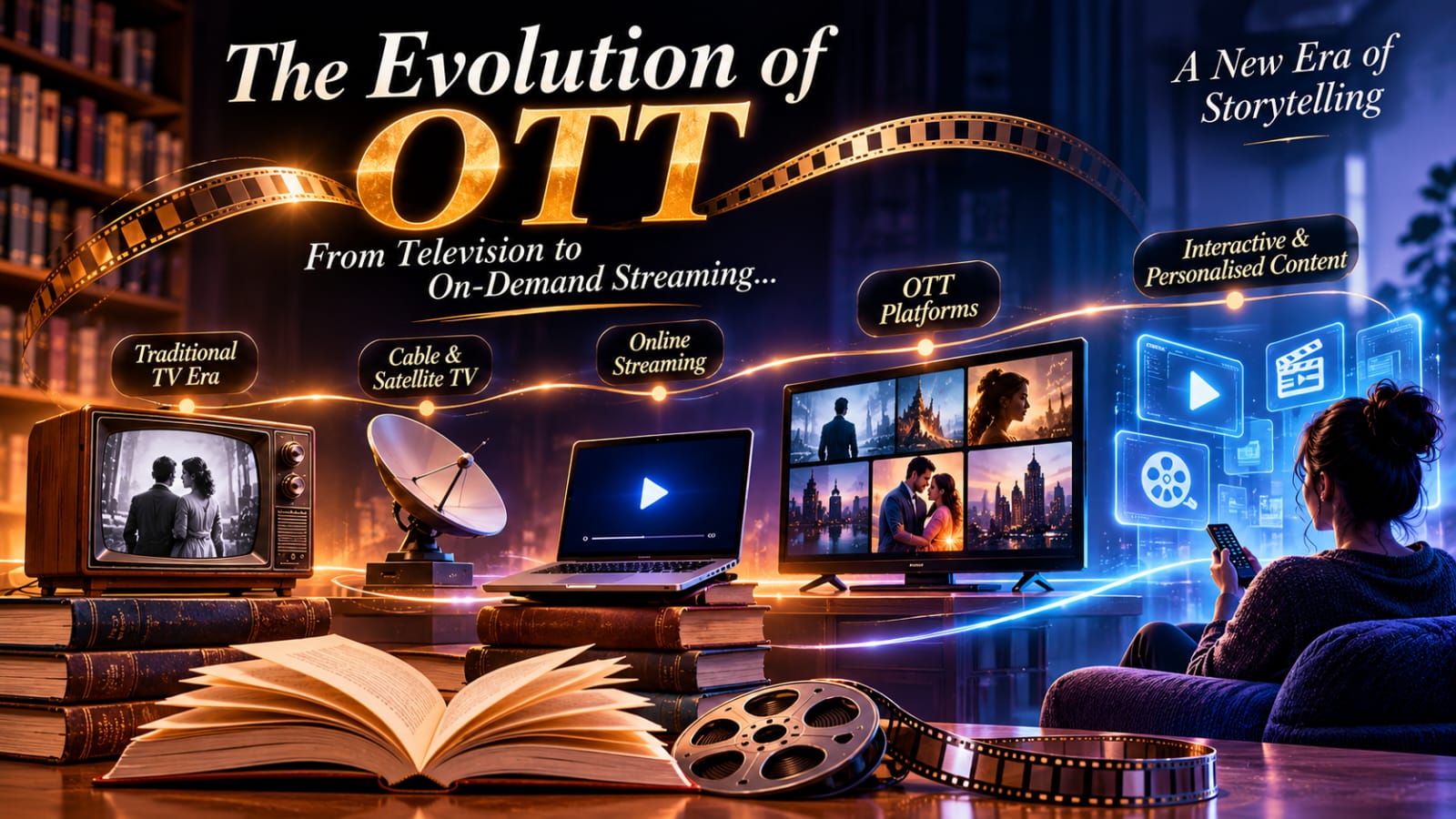
The expansion of digital technology has opened new dimensions in the world of entertainment, with OTT platforms creating a more accessible and evolving relationship between audiences and visual narratives. This article explores the emergence, evolution, and fundamental concept of OTT as a significant form of digital entertainment. It traces the transition from traditional cinema and television to digital streaming platforms while examining changing audience preferences and patterns of media consumption. It also reflects on how OTT has transformed the ways stories are created, presented, viewed
The New Era of Digital Entertainment: The Emergence, Development and Concept of OTT
The role of communication media has always been crucial in the development of human civilization. From time to time, humans have relied on various mediums to express their thoughts, experiences, emotions, and imaginations. Starting from oral traditions, folk tales, folk theater, and handwritten manuscripts, this journey of expression has reached the present era through printing technology, newspapers, radio, cinema, and television.
While radio established its identity in distant regions through sound, television gave a new dimension to entertainment through the coordination of audio and visual mediums, gradually becoming an important part of the daily lives of families and society. In the evening, family members sitting together to watch programs was a common tradition. Especially during the broadcast of serials like “Ramayana”, the collective enthusiasm seen in homes and streets was an example of the fact that communication media are not merely limited to entertainment, but also continually influence the collective consciousness, faith, and cultural identity of society.
The arrival of the Internet gave a new direction to this entire system. It provided a digital medium for information exchange, education, business, and entertainment, connecting different parts of the world through a shared digital platform. Owing to the internet, the speed of communication increased and people began getting new opportunities to access content of their choice; this changing technology and the growing popularity of the internet led to the development of OTT (Over-the-Top) platforms.
The emergence of OTT is not the result of a single technological invention or a sudden event; rather, it is a comprehensive process linked to the gradual evolution of communication technology, increasing availability of the internet, proliferation of digital devices, and the changing needs of viewers.
In the traditional entertainment system, the audience was primarily dependent on mediums like cinema and television. Watching a movie required a designated location and time, whereas to enjoy programs broadcast on television, viewers had to adhere to the schedule set by the broadcaster. In this framework, the viewer’s control over the selection and consumption of content was relatively limited. The expansion of the internet developed the possibilities to reduce this dependency, leading to the emergence of a digital distribution system in which viewers can select audio-visual content according to their convenience, interest, and available time. OTT represents this very transformed system.
Ultimately, continuous technological development in the fields of communication and entertainment has transformed the ways audiences view and understand content. This modern process of Media Convergence paved the way for the development of new mediums like OTT (Over-The-Top). This medium has given a new dimension to the presentation of art, cinema, and storytelling. Entertainment is no longer restricted to a fixed schedule or traditional broadcasting systems. OTT has provided viewers with the freedom to watch content according to their interests, convenience, and time. Thus, viewers are no longer mere consumers of entertainment; rather, they have become much more independent in choosing the medium and opportunity to watch according to their preferences and schedule.
Concept, Nature, and Interrelationship of OTT with Web Series
OTT (Over-The-Top) refers to a digital medium through which various types of entertainment-related content reach viewers directly. These platforms function to deliver films, web series, and other audio-visual content to audiences via the internet. The most prominent feature of these digital mediums is that viewers do not need to depend on traditional television broadcasting, cable networks, or cinema halls to watch content. Instead, viewers can watch their desired content according to their interest and convenience using devices connected to the internet, such as mobile phones, laptops, computers, or smart televisions.
Definition of OTT:
“OTT refers to those media and entertainment services that are delivered directly to consumers via the internet.”
— Anil Kokaram»
Apart from movies and web series, documentaries, news, music, live shows, sports broadcasts, interviews, and various other types of digital content are also available on OTT platforms. One of the key features of these platforms is the facility of Video on Demand (VoD). Under this, a viewer can select and watch any content according to their interest, desire, and convenience. Unlike traditional broadcasting mediums, where viewers have to wait for a fixed broadcast time of a program, they can enjoy it at any time according to their convenience.
However, it would not be appropriate to limit the concept of OTT solely to Video on Demand (VoD) services. This internet-based distribution system also includes services through which live programs, news, or sports competitions are broadcast to viewers at scheduled times. From this perspective, the identity of OTT is not limited only to providing viewers the freedom to watch content at their convenience; rather, its actual foundation is the distribution of digital content via the internet. While Video on Demand is certainly one of its prominent features, the entire working mechanism of OTT does not depend solely on it. Under this, on-demand content as well as real-time broadcast programs hold an equally important place.
The diverse facilities available under OTT have not only transformed the nature of content distribution and broadcasting, but have also influenced viewers' viewing habits and their perspective towards entertainment. Along with this change, a new audience trend such as Binge Watching has emerged. It refers to watching multiple episodes of a program or web series back-to-back. With multiple episodes being available simultaneously under the on-demand system, a viewer can watch them sequentially according to their interest and convenience. Thus, the time for entertainment is no longer determined solely by the broadcaster; rather, the viewer themselves can decide the duration and pace of watching content according to their convenience.
However, this convenience of continuous viewing also raises issues such as time management and maintaining a balance with daily activities. From this perspective, OTT is no longer merely a medium for distributing digital content, but also expresses new trends related to viewers' changing habits, preferences, and consumption of entertainment.
The term OTT (Over-The-Top) in itself expresses the unique nature of this digital distribution system. It points toward a system through which audio-visual content is delivered directly to consumers via the internet. In this process, there is no need to depend on traditional broadcasting systems such as cable networks or DTH (Direct-to-Home) for the distribution of content. However, this does not mean that OTT platforms are completely independent of internet service providers, because the internet is the essential foundation of this entire system. In fact, the uniqueness of OTT lies in that system of content distribution, selection, and consumption which goes beyond the limitations of traditional broadcasting mediums to provide viewers with greater freedom, convenience, and choices.
Before moving forward, it is also necessary to understand the conceptual difference existing between OTT and Web Series. In general practice, these two terms are often used synonymously, whereas in reality, their nature and scope are different.
OTT is fundamentally a medium for internet-based content distribution through which various types of digital content reach viewers. In contrast, a Web Series is a specific genre of audio-visual storytelling, whose narrative development typically takes place through multiple episodes or seasons. A wide variety of content—including films, documentaries, serials, news, sports broadcasts, and web series—can be available on an OTT platform. From this perspective, a web series should be seen as one of the forms of diverse content presented on the OTT medium.
Therefore, the relationship between OTT and web series is that of a medium and its content. Using both as synonyms would be to limit their distinct nature and scope.
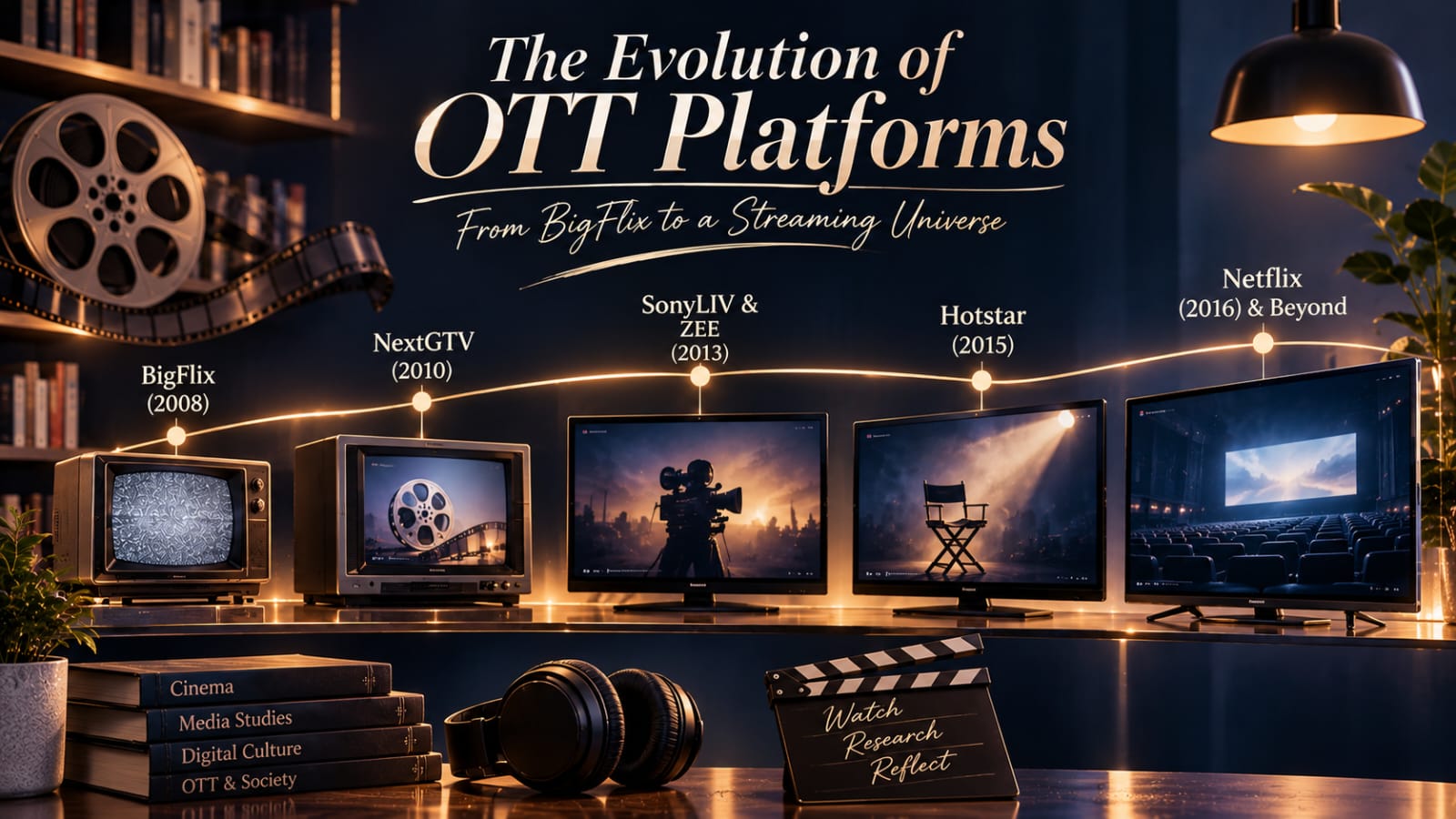
The Development of OTT in India: From BigFlix to Digital Streaming
The Early Phase of OTT in India: BigFlix and nexGTV (2008–2010)
The development of OTT in India has not been the result of a single event, but rather a gradual process that progressed alongside technological changes and the evolving needs of viewers. In its initial phase, there were several challenges such as limited internet speed, low availability, the high cost of digital devices, and consumers' level of technical literacy. During this period, viewing video content was not as effortless and accessible as it is today. For the expansion of OTT services, the mere availability of digital content was not enough; rather, the development of technological infrastructure that enabled viewers to access content easily was also necessary.
In this context, Pankaj Thakur (2021) highlights the launch of BIGFlix in 2008 as a significant early milestone in the Indian OTT sector. This was an initial effort toward internet-based video distribution in the Indian entertainment industry. Although the use of digital media was limited at that time, it laid the foundation for streaming services that would develop in the future. Following this, the increase in internet penetration, the growing availability of smartphones, and consumers' interest in digital services accelerated the expansion of this sector. Particularly after 2015, the surge in the number of internet and smartphone users in India played a crucial role in building a broad audience base for OTT platforms.
Thus, it is essential to understand that the development of OTT in India did not begin suddenly with the COVID-19 pandemic; rather, its technological and commercial background had already been established several years before the pandemic.
To understand the expansion of OTT in India, it is also necessary to consider the relationship established between technological development and social behavior. Any technology creates a widespread social impact only when it begins to fulfill people's needs and becomes an integral part of their daily lives. Smartphones played a crucial role in this direction. Through smartphones, numerous facilities such as communication, information, payments, education, and entertainment became available on a single device. As a result, it was no longer necessary to sit in front of the television every time for entertainment. Viewers could watch digital content while traveling, during leisure time, or at any location according to their personal convenience.
India's youth population also accelerated this transformation. The youth segment, having a comfortable relationship with technology, not only adopted digital entertainment but also began seeking content aligned with their interests and preferences. This changing viewer demand created new opportunities for OTT platforms. These platforms not only made previously popular films and television programs available in digital format, but also developed a new space for the creation and broadcasting of original content.
According to Sundaravel and Elangovan (2020), to understand the expansion of OTT platforms, it is necessary to simultaneously consider various aspects such as their technological foundation, market, audience characteristics, content, and regulation.
In fact, the growth of OTT has also transformed the role of the viewer. While in the traditional broadcasting system, the viewer was relatively more dependent on available programs and their fixed schedules to watch content, OTT has provided them with greater freedom to choose content according to their preference, select languages, and set their own viewing times. However, along with this convenience, challenges such as the increasing availability of content, the trend of continuous viewing (Binge Watching), and time management have also emerged.
In the development of Indian digital entertainment, the launch of nexGTV in 2010 is also considered a significant milestone. Started by the Gurugram-based company Digivive, this mobile app provided a new dimension to the broadcasting of internet-based video content in India. On this platform, along with Video on Demand, the facility to watch live television was also available.
The significance of nexGTV is noteworthy from the perspective that it brought forth the possibilities of accessing entertainment content through mobile devices. At that time, the use of mobile phones was primarily focused on communication and limited digital services; however, internet-based video services played a crucial role in developing the mobile device as an alternative medium for entertainment.
Following this, during the years 2013–14, the live broadcast of Indian Premier League (IPL) matches was made available for mobile viewers on nexGTV. This instance of sports broadcasting helped bring to light the practical utility of mobile-based streaming. The convenience of watching a popular sport like cricket on mobile via the internet provided viewers with a new alternative beyond traditional television broadcasting. In this manner, during the early phase of Indian digital entertainment, nexGTV expanded the possibilities of mobile-based video streaming while also preparing a crucial foundation for the OTT platforms that would develop in the future.
The Expansion of Indian Digital Streaming: The Advent of SonyLIV (2013)
Around the year 2013, the expansion of digital video services in India began to become more clearly visible. During this same period, digital platforms such as Zee’s DittoTV and SonyLIV emerged, giving a new direction to internet-based entertainment.
The objective of DittoTV was to make content from various major media networks available on a single platform. Under this, an effort was made to deliver programs from networks such as Star, Sony, Viacom, and Zee to viewers via digital media. This initiative developed new options for viewers to select and watch content. This arrangement of making content from different broadcasting networks available on a single digital platform was an indicator of the changes taking place in the Indian entertainment industry.
Through this, the role of the internet was no longer limited solely to information retrieval and communication, but it also began to establish itself as an important medium for video content distribution and entertainment.
Expansion of the OTT Market: The Arrival of Hotstar and Netflix (2015–2016)
With growing competition in the field of digital entertainment, content diversity also began to assume great significance. Different platforms started reaching audiences through sports, films, television programs, and original web series. This provided creators with new platforms for their stories and offered viewers a wider array of entertainment options.
In this sequence, the launch of Hotstar in 2015 marked an important milestone in the development of Indian OTT. In particular, the digital availability of cricket and television content played a key role in popularizing it among viewers. Following this, in January 2016, Netflix launched its services in the Indian market. Later, with the arrival of other platforms including Amazon Prime Video, competition in this sector intensified.
In this manner, OTT was no longer merely a new medium for consuming entertainment content, but emerged as a comprehensive digital platform influencing content creation, distribution, and audience preferences.
Along with this expansion, diversity was also seen in the business model of the Indian OTT sector. Different platforms adopted subscription-based, advertisement-based, and pay-per-view systems to reach audiences.
The subscription-based system is called Subscription Video on Demand (SVOD), in which the viewer watches content by paying a fixed fee. Netflix has been a prime example of this.
On the other hand, in the advertisement-based model (AVOD), content is made available to viewers without a direct subscription fee, with advertisements shown in between.
Additionally, under Transactional Video on Demand (TVOD), a separate payment must be made to watch a specific film or program.
Platforms like Hotstar also reached different segments of viewers through both advertisement- and subscription-based offerings.
In this manner, the business model of OTT was not limited to a single payment structure, but evolved according to the preferences, convenience, and financial capacity of the viewers. This makes it clear that the identity of OTT is not determined by a subscription model, but by the system of delivering digital content via the internet.
Mass Expansion of Digital Entertainment After Jio (Post-2016)
The entry of Reliance Jio into the Indian telecommunications market in September 2016 is seen as a significant turning point in the country's digital landscape. This transformation is commonly referred to as the 'Post-Jio Effect'. Before Jio's arrival, internet usage in India was relatively expensive. Particularly in rural and semi-urban areas, limited internet availability and high data costs acted as barriers to the expansion of digital services.
Low-priced data plans and features such as free voice calls made internet usage much more accessible. This had a direct impact on digital entertainment. Viewers who previously kept their distance from watching online video content now began watching films, web series, and other digital material via their mobile phones. Consequently, audiences in smaller towns and rural areas gradually became part of the broader viewership base of OTT.
A major impact of Jio’s arrival emerged in the form of an increase in internet data consumption. With more data available at lower prices, the time spent by people on the internet increased, and video streaming became a major component of digital consumption. This also expanded the trend of watching online video content on platforms such as YouTube, Netflix, Amazon Prime Video, and Hotstar.
The growing audience base and the demand for digital content intensified competition in the OTT sector. Platforms like Hotstar, ZEE5, Netflix, and Amazon Prime Video increased their investments toward improving their content, technological features, and viewer experience. Along with this, keeping the preferences of Indian viewers in mind, focus was also given to local languages and regional stories.
The growing competition between international and Indian platforms provided viewers with a wider array of entertainment choices. In this manner, Jio's impact was not limited merely to a reduction in internet prices; rather, it also influenced internet usage, data consumption, the accessibility of digital entertainment, and the expansion of the OTT industry.
The COVID-19 Pandemic and the Widespread Popularity of OTT
A discussion on the development of OTT in India would remain incomplete without reference to the COVID-19 pandemic. The lockdowns imposed during the pandemic and restrictions on public activities extensively impacted people's daily routines. Movie theaters closed down, the production of numerous film and entertainment projects was disrupted, and people began spending most of their time at home. Under such circumstances, digital entertainment provided viewers with an alternative medium to access audio-visual content.
However, OTT platforms existed even before the pandemic and their usage was steadily growing. Therefore, it would not be appropriate to say that the COVID-19 pandemic gave birth to OTT; rather, it can be stated more accurately that the pandemic accelerated the expansion and popularity of this already developing medium. Life restricted to homes, the non-availability of traditional entertainment options, and content easily accessible via the internet drew viewers' inclination toward digital platforms.
In their study, Jhala and Patadiya (2021) discussed consumer behavior and the increasing usage of OTT platforms during COVID-19. In the same context, Pankaj Thakur (2021) also highlighted the pandemic as a crucial catalyst in the expansion of the Indian OTT sector. These studies bring forward the idea that the pandemic not only attracted viewers toward digital content, but also transformed their viewing behavior and entertainment preferences.
The study by Patnaik, Shah, and More (2021) presented survey-based findings related to OTT usage during the pandemic. According to this study, 91.7 percent of respondents were aware of OTT platforms, while 72.7 percent of respondents used OTT for entertainment. Meanwhile, 17.3 percent of respondents chose YouTube as their entertainment option. Additionally, the study highlighted the changes that occurred during the pandemic regarding content viewing duration, devices used, and viewers' watching habits.
The study by Patnaik, Shah, and More (2021) also presented statistics related to the respondents' content viewing duration. According to the study, 42.7 percent of respondents watched OTT content for two to four hours daily, while 29.1 percent spent more than four hours a day watching it. Meanwhile, 28.2 percent of respondents watched digital content for less than two hours per day.
These statistics are based on the survey sample of the specific study and should not be considered representative of the behavior of all viewers. Nevertheless, they point toward the fact that digital content consumption time is an important basis for understanding the growing impact of OTT.
In this context, Wagh et al. (2022) studied the impacts of web series and online streaming content on Indian youth. In their research, some respondents mentioned difficulties related to sleep, academic performance, and social relationships. The study also discussed how the habit of continuous digital content viewing (Binge Watching) can affect an individual's daily routine and time management.
Thus, the COVID-19 pandemic was not merely a temporary situational shift for the Indian OTT landscape; rather, it gave a new direction to viewers' entertainment habits, digital content consumption, and their relationship with audio-visual media. The increasing usage of OTT during the pandemic also made it clear that entertainment was no longer confined solely to movie theaters or traditional television; instead, internet-based platforms were establishing themselves as an important medium tailored to the changing needs and preferences of the audience.
Following the pandemic, competition among OTT platforms became even more extensive. Platforms such as Netflix, Amazon Prime Video, Disney+ Hotstar, and JioCinema focused heavily on producing and streaming original content based on diverse languages and themes to attract audiences.
An important outcome of this competition was that, alongside Hindi, content in Tamil, Telugu, Malayalam, Kannada, Bengali, and other regional languages began finding a wide audience base. This gave linguistic diversity a new identity in the Indian entertainment industry, allowing regional stories to reach audiences at a national level.
Additionally, the scope of content expanded beyond web series to include films, documentaries, presentations based on real-life events, and projects centered around various social themes. OTT platforms provided a space for stories that traditionally received relatively fewer opportunities in mainstream commercial cinema. As a result, there was an increase in both the quantity and visibility of presentations based on subjects such as women's lives, caste inequality, social struggles, political circumstances, crime, family relationships, and changing social mindsets.
On the other hand, a shift was also visible in the relationship between theaters and OTT platforms after the pandemic. Some films began to be made available on digital platforms only after being released in theaters first, while other productions marked their presence directly on OTT. This process affected the traditional patterns of film production, distribution, and exhibition.
A notable change was also observed in audience behavior. Now they were no longer limited to just popular actors or big-budget films; instead, they began selecting content based on subject matter, storyline, acting, and presentation. Recently, along with this expansion of OTT, questions related to subscription fees, the quality of digital content, content fatigue (overabundance of material), viewing habits of audiences, and regulation also emerged.
Thus, the post-COVID-19 period was not merely a time for the Indian OTT industry to sustain the popularity gained during the pandemic, but it was also a time for the restructuring of its form, commercial structure, thematic diversity, and relationship with audiences. It is clear that the digital entertainment trend accelerated by the pandemic began to evolve into a significant part of post-pandemic Indian entertainment culture.
Conclusion
The rise of OTT in India is a reflection of the changing landscape of entertainment and the new demands of society. Technological development, increasing internet penetration, and the availability of smartphones have taken entertainment beyond the boundaries of homes and connected it to the personal preferences and convenience of viewers. OTT has not only changed the way content is consumed, but it has also given a new dimension to the relationship between audiences and entertainment. Now, viewers can engage with stories of their choice according to their interest, time, and convenience.
The accessibility of the internet after 2016 and the entry of Reliance Jio played a significant role in the growth of Indian OTT. Low-cost internet services helped bring digital content to a wider section of society. Subsequently, the COVID-19 pandemic accelerated this process even further. During the lockdown, when traditional options for entertainment became limited, OTT platforms emerged as an effective medium for audiences. Recently, the continued popularity of these platforms even after the pandemic indicates that OTT is no longer just a situational necessity, but has become a part of a changing lifestyle.
Ultimately, the advent of OTT in the history of communication and entertainment is not merely the arrival of a new digital platform; rather, it has brought about a comprehensive transformation in the ways audio-visual content is produced, distributed, and consumed. Moving past the limitations of traditional entertainment mediums, it has developed a digital media system where viewers can choose content according to their interest, time, and convenience.
However, alongside this, questions related to digital literacy, screen time, content appropriateness, and ethical regulation are also attached. Nevertheless, it cannot be denied that OTT has carved out an important place for itself in modern entertainment culture. It has transformed entertainment, bringing it beyond the boundaries of movie theaters and television straight into the hands of viewers. Thus, OTT has emerged as a medium representing the evolving nature of new media—a space where stories transcend linguistic and geographical boundaries to reach diverse audiences, providing an opportunity to connect with their experiences, emotions, and ideas.
References
-
Anil Kokaram, Regis Crinon & Nicolas Catania, “OTT (Over-The-Top) in 2015,” SMPTE Motion Imaging Journal, 2015.
-
TechCircle (2012): “DigiVive Launches Live TV App nexGTv; How Good Is It.”
-
Thakur, P. (2021). “A Remarkable Evolution of Over-the-Top Media Platforms in India: A Case Study of Business and Regulatory Trends.” Global Media Journal, 19(42).
-
Sundaravel, E., & Elangovan, N. (2020). “Emergence and Future of Over-the-Top (OTT) Video Services in India: An Analytical Research.” International Journal of Business, Management and Social Research, 8(2), 489–499.
-
Jhala, & Patadiya. (2021). “Study on Consumer Behavior and OTT Usage During the COVID-19 Era.”
-
Patnaik, Shah, & More. (2021). “A Study on the Rise and Usage of OTT Platforms During the COVID-19 Pandemic.”
-
Wagh, D. V. W., Deshpande, P. R. G., Patil, P. K. S., & Hadole, P. S. V. (2022). “A Study of Impact of Web Series and Streaming Content on Youth of India.” Journal of Positive School Psychology, 6(2), 392–397.