
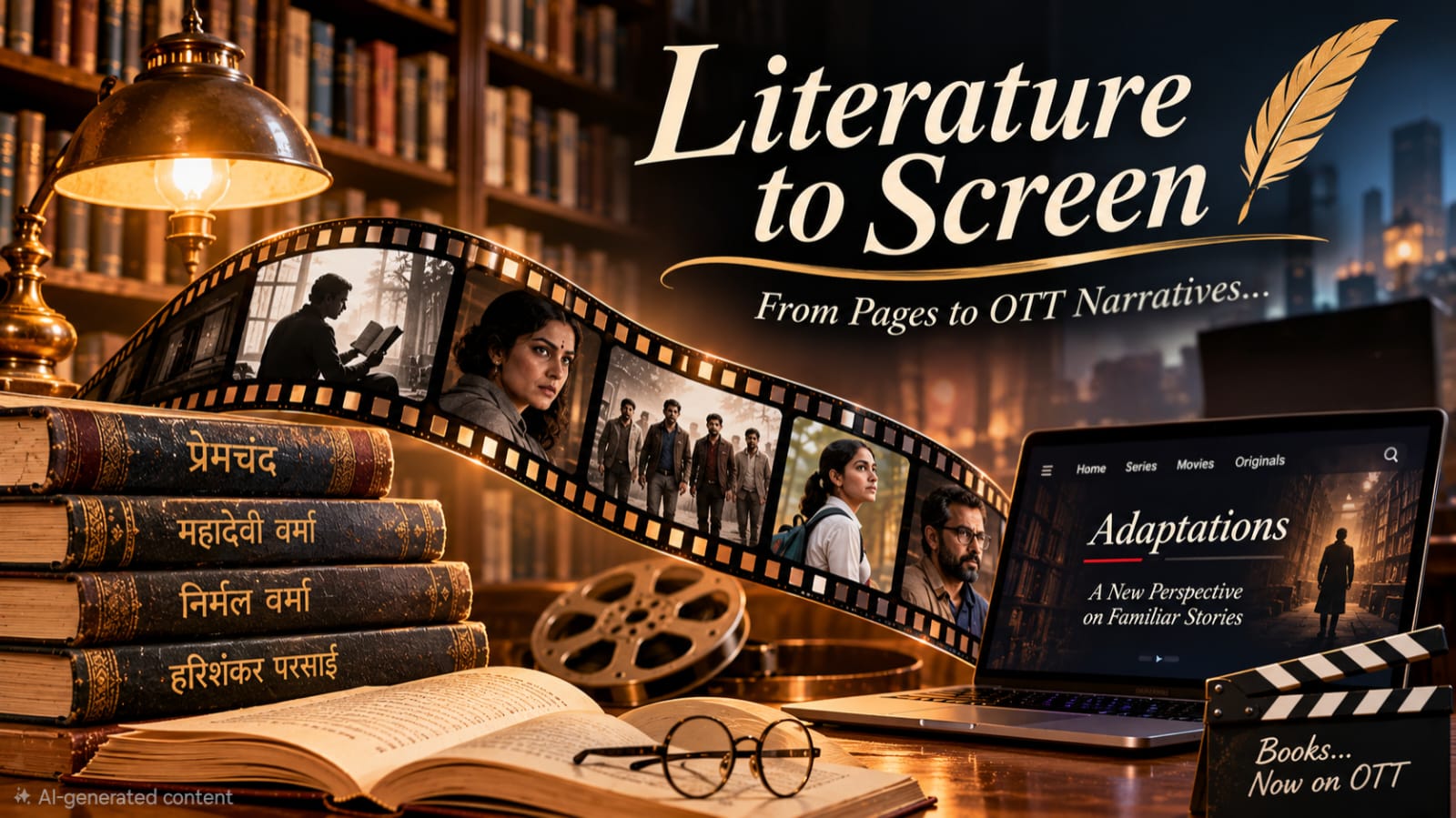
Some stories do not remain confined to the pages of a book; they travel across time and find new expressions on screen. This section explores the adaptation of literary works into cinema and OTT narratives, examining how stories transform across different visual mediums. It engages with the shifts in themes, characters, language, emotions, narrative structures, and socio-cultural contexts between the original text and its screen adaptation. Rather than focusing merely on similarities or differences, it seeks to understand how a change of medium reshapes the meaning, perspective, and experience
From Words to Visuals: Cinematic and Digital Adaptation of Literary Works
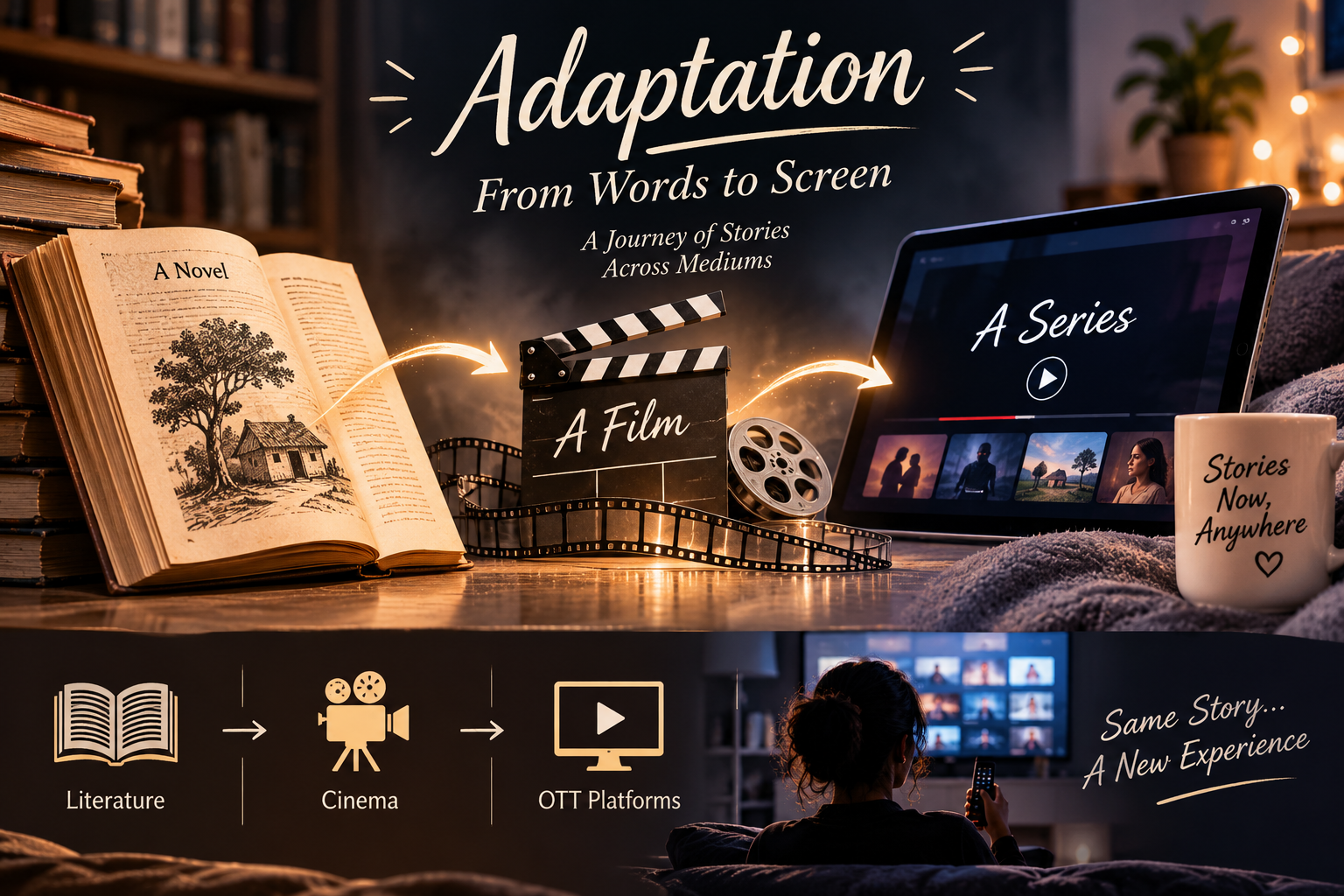
The tradition of storytelling has never been confined to a single medium or technology. Before the development of written language, oral expression was the primary basis for the exchange of ideas, experiences, and collective memories. Social experiences continued to be passed down from generation to generation through folk songs, folktales, and narratives. Following this, script, painting, printing, and visual media gave new dimensions to narrative expression. This journey—from stories told around a fire to handwritten manuscripts, cinema, and today's digital screens—shows that while mediums have inevitably changed over time, the expression of storytelling has remained continuous.
In this long cultural journey, the transformation from literature to cinema and from cinema to digital screens—especially through ओ.टी.टी. platforms and web series—emerges as a significant chapter. This journey is not merely the process of turning written words into visuals; rather, it is an endeavor to mold imagination, sensibility, time, memory, and social reality into the expression of a new medium. When life, which takes shape through words in literature, reaches visual media, it brings along the emotional essence and ideological foundation of the original work, yet new meanings and experiences continue to be added in accordance with the nature of the new medium. When a novel takes the form of a film, a story comes alive on the television screen, or a literary work reaches audiences through a web series, the original work enters a new creative environment. Its characters get faces, dialogues receive voices, the setting gains visual expansion, and the world that took shape in the reader's imagination becomes part of a collective visual experience.
This relationship between literature and visual media is not one-sided, but rather one of mutual dialogue, exchange, and creative extension. While literature provides cinema and other visual media with plotlines, characters, social insights, and ideological depth, cinema, in turn, connects literary works with new possibilities of visuality, sound, acting, music, and interpretation, serving as a medium to bring them to a broader audience. Although the expressive techniques of both media differ, their fundamental desire to understand and express human beings, their inner conflicts, relationships, and social environments intersects at many levels. For this reason, the adaptation of literary works into visual media is not merely presenting a story in a different medium, but also granting a new form of expression to the experiences and meanings embedded within it.
A fundamental difference between these two media also lies in imagination and visual presentation. The reader of literature personally imagines the face, voice, gait, expressions, and surrounding environment of a character. Based on the words and descriptions provided by the author, the reader constructs a world in their own mind whose form can vary according to the experience, sensibility, and imagination of each individual reader.
In contrast, in visual media, the characters and the environment appear before the audience in a concrete visual form. There, a character's face takes shape through the casting and performance of the actor, their costume, the director's vision, cinematography, and other artistic decisions. Thus, while literature allows the reader the opportunity to enter the world of a work through their own imagination, cinema and other visual media provide that world with a specific visual form. Where literature leaves ample space for imagination, visual media attempt to give concrete shape to that imagination with the help of visuals, sound, and performance.
A natural question arises here: when a literary work is presented on screen, does it lose its original form and soul, or does it acquire new significance and expression by entering a new medium? The answer to this question cannot be limited to a single conclusion. The validity of an adaptation lies in how the creator integrates the sensibility of the original work, its internal contradictions, character complexities, and social contexts with the nature and requirements of the new medium. In this context, Satyajit Ray's approach to literary adaptation is notable.He said -
"I've made seventeen or eighteen films now, only two of which have been original screenplays , all the others have been based on short stories or novels , and I find the long short story ideal for adaptation"
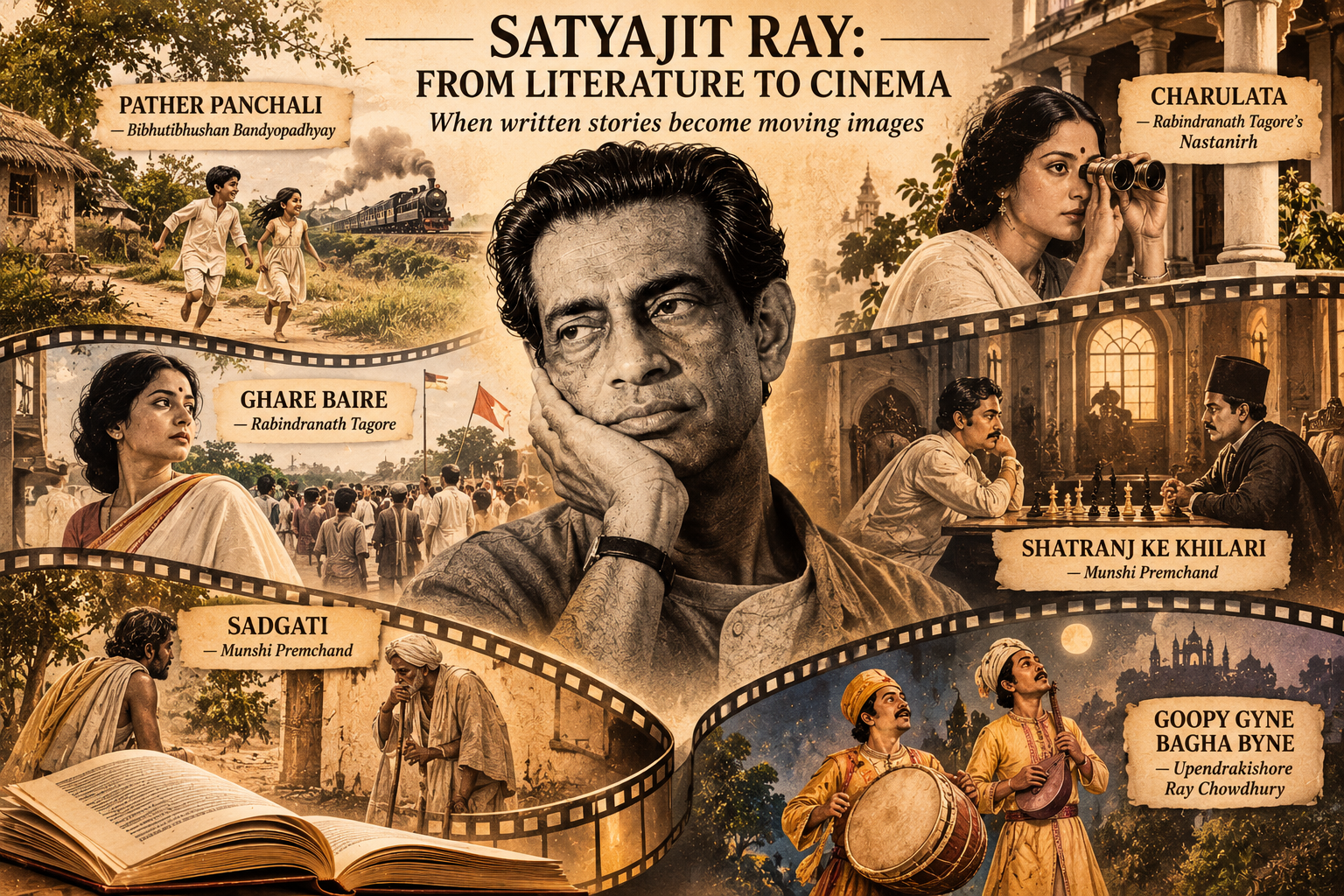
Many of his films have been based on stories and novels. His creative experience underscores the fact that literature provides a rich foundation for visual narrative, but bringing a work to the screen is not merely following its events; rather, it is understanding the sensibility, thought, and life experience embedded within it and re-expressing them in a new medium.
The Historical Journey of Storytelling: From Oral Narratives, Theatre, and Print to Modern Screens
The history of the storytelling tradition began long before the arrival of modern technology. Humans have always relied on stories to express their experiences, memories, imaginations, and social lives. In Indian culture, storytelling has not merely been a means of entertainment, but also a powerful medium for transmitting knowledge, ethics, social consciousness, and cultural values from one generation to the next.
The Ramayana, Mahabharata, Jataka tales, Puranas, and various folktales profoundly influenced the imagination and worldview of the Indian populace. The dissemination of these narratives was not restricted solely to written texts; rather, it continued to spread through oral traditions, folk theatre, Ramlila, Raslila, Nautanki, puppetry, and collective performances. Thus, while the form of storytelling evolved over time, its connection with human life and society has remained unbroken.
When a narrative journeys from one medium to another, it carries with it not just the plot, but also the culture, social beliefs, and collective memories of that era. The epics of the Ramayana and the Mahabharata have been presented across different time periods in various languages, poetic forms, and theatrical styles. Every era attempted to understand and express these ancient narratives in accordance with its own circumstances and ideological needs. In this process, literary genres such as poetry, short stories, and drama endowed the storytelling with new forms and new meanings. Thus, the adaptation of narratives was not merely a change in their presentation, but also a process of their re-reading and re-creation in every new age.
In this historical journey of storytelling, the advent of print culture proved to be a significant milestone. Moving beyond the limitations of handwritten manuscripts, when printed books began to circulate, the reach of literature became possible to a wider readership. The novel genre, in particular, provided the opportunity to express in detail man's personal life, his memories, mental conflicts, class struggles, and changing social structures. The greatest feature of the novel was that in it, the author could portray the emotional states of characters, their inner conflicts, social background, and the subtle circumstances of life in detail. For this reason, the novel later became a rich foundation for plot construction, character development, and screenplay creation for cinema and other visual media.
In this process of moving from printed literature to visual media, theatre acted as an important bridge. Theatre was the medium where written words were first seen transforming into a living experience through acting, dialogue, body language, and the direct presence of an audience. Here, literary stories were not merely read, but unfolded before the audience through the actors' performances and stage visualization. This developed a relationship between literature and visual expression that later paved the groundwork for cinema as well. Theatre demonstrated how the emotions, thoughts, and events of a written work could become much more direct and impactful through performance and visual presentation.
Following this, the advent of cinema provided a new artistic language to the storytelling tradition. Through motion pictures, lighting, cinematography, sound, music, and editing, a medium of storytelling was developed in which literary imagination began to be transformed into visual and auditory experiences. Cinema not only liberated the presentation of narratives from the limitations of the stage, but also developed new possibilities for presenting time, space, memory, and events.
In the context of understanding the relationship between literature and cinema, George Bluestone's 1957 book Novels into Film is especially notable. He emphasized understanding the novel and the film as two distinct artistic mediums. While the novel constructs mental images within the reader with the help of words, cinema creates its own physical and emotional world through visuals and sound. Therefore, in the film adaptation of a literary work, merely following the events of the original work is not enough; rather, it is also essential to present its sensibility and underlying meanings in accordance with the expressive mode of the new medium.George Bluestone's theoretical perspective emphasizes that-
"A novel and a film are two distinct artistic mediums. The novel creates images through words, whereas cinema constructs its narrative through visuals and sound"
Since the early era of Indian cinema, it has shared a deep and intimate relationship with literature. The linguistic diversity, social complexities, and rich narrative traditions of Indian society continuously inspired filmmakers. The works of literary figures such as Bankim Chandra Chattopadhyay, Sharat Chandra Chattopadhyay, and Munshi Premchand provided Indian cinema with new dimensions of plotline, social depth, and human emotion. The social reality, familial relationships, human struggles, and character complexities present in their stories and novels became crucial creative foundations for filmmakers. The extension of this tradition later reached television, where literary works found a new identity among audiences through serials and other programs.
Over time, this expansion of visual media reached digital technology and modern screens. ओ.टी.टी. platforms and web series added new dimensions to the methods of storytelling and content consumption. The adaptation of novels, stories, and other literary narratives was no longer bound to a limited-runtime film or a television serial; rather, possibilities developed to present intricate plots, multiple characters, parallel storylines, and social discourses across multiple episodes.
Thus, the journey of storytelling, which began in the oral tradition, passed through print, theatre, and cinema to reach the modern digital screen. Mediums have changed, and forms of expression have evolved, yet the fundamental human instinct to understand and share human life, experiences, and the realities of one's time through narrative remains as continuous as ever.
Indian Cinema and Television: The Evolving Tradition of Literary Adaptation
Indian cinema has shared a deep and intimate relationship with literature since its inception. The linguistic diversity, social complexities, cultural traditions, and rich narratives of Indian society have always inspired filmmakers. Literature provided cinema not just with plotlines, but also with a perspective to understand the diverse experiences of life, human emotions, and social reality. The works of literary figures such as Bankim Chandra Chattopadhyay, Sharat Chandra Chattopadhyay, and Munshi Premchand accorded Indian cinema narrative depth through which the interrelationships between the individual and society could be expressively communicated.
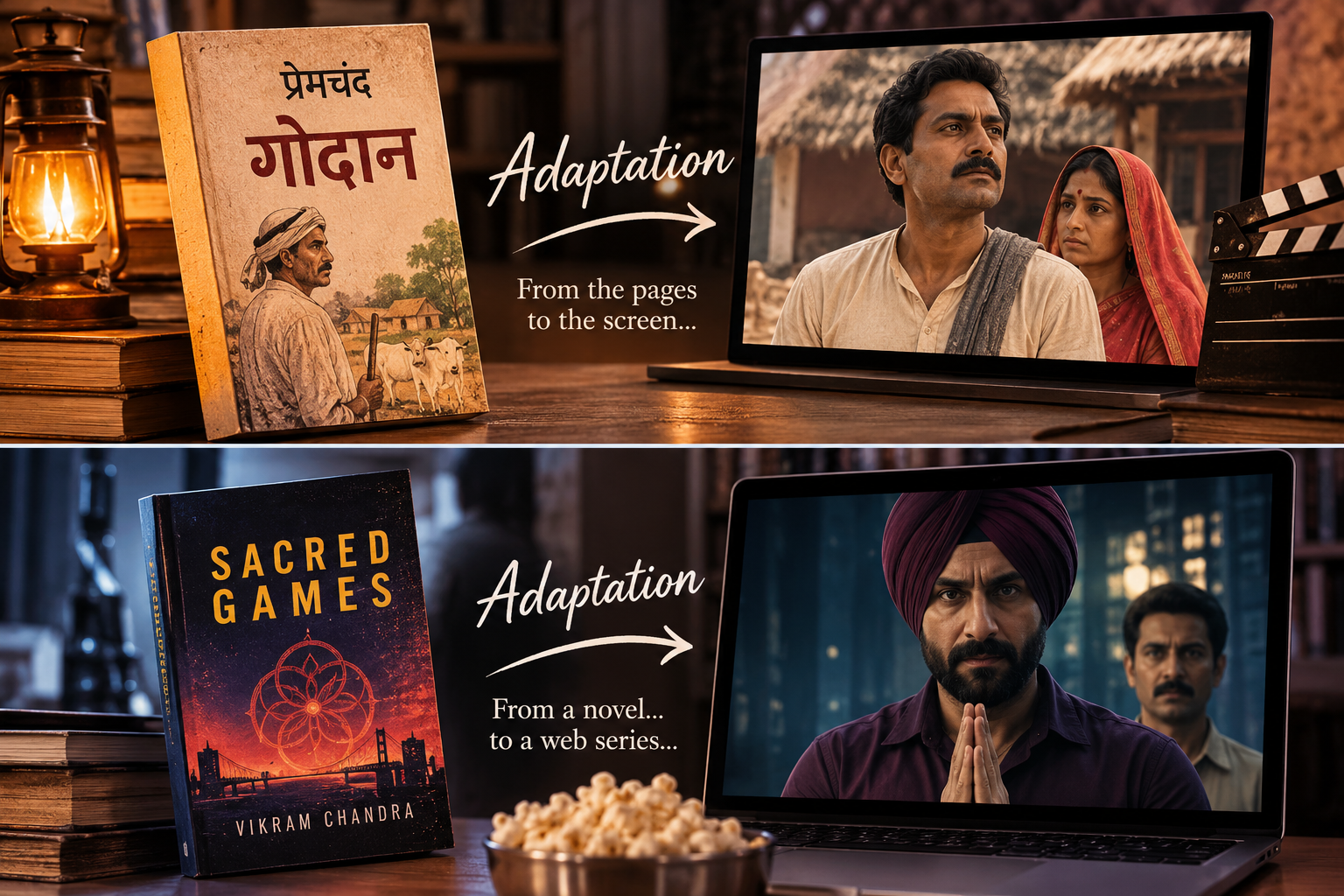
Particularly, the literature of Munshi Premchand presents an authentic narrative of conditions in Indian rural and small-town life, deeply intertwined with issues like economic disparity, the exploitation of farmers and laborers, caste discrimination, and moral struggles. When the literary works of Premchand and Sharat Chandra reached the silver screen, they did not merely present emotional stories before the audience; rather, they also developed a framework for observing and understanding the inequalities, contradictions, and human struggles prevalent within society. Thus, the film adaptation of literary works was not merely an attempt to repeat popular stories, but became a creative medium to re-represent social questions raised in the past within the context of new times and circumstances.
Following cinema, the arrival of television in Indian cultural life brought a new chapter in the presentation and appreciation of storytelling. While cinema provided audiences with a collective visual experience inside a public auditorium, television delivered those very visual narratives directly into homes, amidst family and daily life. This gave a new social dimension to the dissemination of literary and mythological epics.
In the history of Indian television, serials like Ramanand Sagar's Ramayan and B. R. Chopra's Mahabharat hold special significance in this regard. These serials provided a visual expression to the mythological narratives already deeply ingrained in the Indian populace, bringing them to a vast and diverse national audience.
An important contribution of television was that it provided a serial or episodic structure to storytelling. While films develop a plot and its characters within a limited duration, television serials offer greater time and opportunity to elaborate on events, relationships, and characters. Over the course of stories broadcast across many months—and sometimes even years—audiences begin to develop an emotional and intimate connection with them. They gradually become involved with the characters' lives, their joys and sorrows, their struggles, and their evolving relationships.
This episodic structure later became an important foundation for the development of web series in the digital era. Thus, by advancing the tradition of literary adaptation, Indian cinema and television developed new dimensions of story, character, dialogue, and visual representation—the expansion of which is present before us today in the form of ओ.टी.टी. platforms and web series.
The Changing Process of Literary Adaptation: From Creative Challenges to Digital Narratives
In the process of literary adaptation, a continuous creative dialogue is maintained between the original work and its new visual form. This process cannot be viewed merely as a copy or mechanical reproduction of a preceding literary work, because every medium has its own mode of expression, structure, and artistic requirements. In this context, Linda Hutcheon's book A Theory of Adaptation provides a significant theoretical foundation for the study of adaptation. According to Hutcheon, adaptation is an independent, creative, and interpretive process in which a prior work is re-presented in a new medium and new contexts. From this perspective, adaptation is not merely an effort to maintain fidelity to the original work, but also a process of developing the meanings, sensibilities, and ideas embedded within it within a new creative environment.According to Linda Hutcheon's theoretical perspective-
"Adaptation is an independent creative and interpretive process through which an existing work is re-presented in a different medium and within new contexts"
When a literary work is adapted for the screen, the creator faces challenges on multiple levels. The primary challenge among these lies in transforming the language and its literary sensibility into visual expression. The power of literature lies not merely in its words, but also in its linguistic structure, imagery, symbols, metaphors, and the author's distinct style of expression. In a novel or story, an author can use words to elaborate on the mental states of characters, their unsaid emotions, and their internal conflicts; however, in cinema, these very feelings must be presented through acting, dialogue, music, lighting, cinematography, and sound. In this process, it becomes essential for the screenwriter and director to grant a new form to its language in accordance with the nature of the visual medium while preserving the emotional essence of the original work.
Along with this, the expansion of the plot and the handling of time also constitute a significant challenge in adaptation. In a novel, the author gets ample space for the development of events, episodes, and characters. They can express a character's mental journey, family background, and social circumstances across numerous pages. In contrast, a film has to convey the main episodes and central theme of a story to the audience within a limited timeframe. In such a situation, during the creation of the screenplay, the selection of certain episodes, the condensation of certain events, and the rearrangement of certain subplots become necessary.
Similarly, character development is also a sensitive aspect. While reading literature, the reader constructs the face, personality, and gestures of characters according to their own imagination, whereas on screen, an actor's face and performance provide that character with a definitive visual identity. At times, this presentation may also differ from the reader's preconceived imagination. Therefore, the director and screenwriter face the challenge of making characters visually credible while preserving their core nature, internal conflicts, and human complexities.
Understanding the social, cultural, and historical contexts of the original work during adaptation is equally essential. The plot of a literary work is not merely a sequence of events; rather, it is also connected to the social structure, beliefs, traditions, and ideological circumstances of its time. If these contexts are ignored during adaptation or altered more than necessary, the ideological foundation of the original work can be compromised. On the other hand, making some changes while keeping the new medium and the tastes of contemporary audiences in mind may also be necessary. Therefore, a successful adaptation is one that strikes a balance between blind devotion to the original work and complete freedom. Its objective should not be to present every event of the original work exactly as it is, but rather to meaningfully express its central sensibility, human experiences, and ideological depth in the new medium.
Meanwhile, in the second decade of the twenty-first century, the rapid expansion of the internet and digital technology brought about comprehensive changes in the nature of entertainment and mass communication. This transformation not only altered the methods of production and broadcasting of audio-visual content, but also influenced the role of audiences and their viewing habits. In traditional broadcast media, viewers had to rely on fixed schedules and broadcast programs to watch content of their choice, whereas the internet provided them with the freedom to choose content according to their own convenience, interest, and time. Thus, the entertainment experience evolved from a predetermined broadcast system toward a trend of individual selection and viewing content on demand.
In the Indian digital landscape, the growing availability of the internet and the expansion of telecommunications services were significant factors behind this shift. The data presented in the Telecom Regulatory Authority of India (TRAI) report, Achievements in Digital Communications 2014–2020, highlights the scale of this change. According to the report, the number of internet subscribers in India was approximately 238.71 million (23.871 crore) in 2014, which rose to approximately 776.45 million (77.645 crore) by 2020. This remarkable growth in internet reach created a vast foundation for the production, distribution, and consumption of digital content. Around 2016, affordable data services and the increasing adoption of smartphones gave further momentum to this process. Particularly after the arrival of Reliance Jio, the availability of internet services and low-cost data plans played a crucial role in bringing digital entertainment to a broader segment of society. As a result, a vast potential market developed among Indian audiences for ओ.टी.टी. platforms such as Netflix, Amazon Prime Video, Hotstar, and MX Player.
The role of independent and innovative digital groups, such as The Viral Fever (TVF), has also been remarkable in the development of Indian digital storytelling. The web series Permanent Roommates, broadcast in 2014, is considered a significant milestone in the evolution of Indian digital entertainment. It established that through the internet, not just short comedy films, but also detailed narratives based on love, marriage, complexities of relationships, careers, and the everyday struggles of youth could be effectively presented. This gave a new direction to the possibilities of episodic storytelling on digital platforms. It was no longer necessary to rely solely on traditional broadcasting institutions and predetermined formats for storytelling. Independent creators and producers began to find opportunities to present their ideas, experiences, and social observations in novel ways.
To understand this new narrative structure developing on digital mediums, the studies of researchers like Aymar Jean Christian—who has reflected on independent online video production and the changing structure of digital narratives—are useful. In the same vein, Dan Williams's book Web TV Series: How to Make and Market Them (2012) presents a significant reference for understanding web-based series' production, screenplay structure, and changing marketing strategies. Digital mediums have given creators the freedom to experiment beyond the predetermined broadcasting systems and commercial limitations of traditional television. This has not only brought diversity to the subjects of stories, but has also enabled new experiments in their presentation, dialogues, characters, and styles of visual representation.
The format of the web series has also provided a new and expansive opportunity for literary adaptation. Especially for long and multi-layered novels, this format appears to hold greater potential for presentation in a visual medium. Due to the limited runtime of a traditional film, subplots, minor characters, and social nuances of a literary work often have to be condensed; whereas the multi-layered and episodic structure of a web series is capable of giving the narrative relative breadth. Through this, the lives of multiple characters, their mutual relationships, personal struggles, and social circumstances can be developed across different episodes. Thus, new possibilities emerge for presenting the narrative expanse and character complexities present in a literary work in a visual form.
In this context, the example of the web series Sacred Games, based on Vikram Chandra's novel, is remarkable. This adaptation provided visual expanse to the novel's detailed plot, numerous characters, socio-political contexts, and parallel events through an episodic structure. It sparked significant discourse regarding the possibilities of presenting literary narratives in the digital medium, alongside their new interpretation and presentation. Thus, the web series not only reached a new audience demographic with the literary work but also provided an opportunity to expand its narrative universe.
Looking at this entire process, it can be said that the development of digital mediums is not merely a technical change in the tradition of literary adaptation, but an expansion of new opportunities for expression. The storytelling tradition—which evolved from oral narratives through printed literature, theatre, cinema, and television—is now taking on new forms via ओ.टी.टी. platforms and web series. Here, adaptation is no longer limited to merely bringing a preceding story or novel to the screen; rather, it becomes a process of re-reading, reinterpreting, and re-creating the original work in contemporary contexts. Along with changing mediums, the structure of the narrative, its presentation, and its relationship with the audience also transform. Yet, amidst all these changes, the fundamental sensibility of literature, human experiences, and the aspiration to express the social reality of one's time remain consistently enduring.
Diverse Dimensions of Literary Adaptation: Key Examples and Case Studies
To understand the changing trends of literary adaptation, the study of web series that have given literary works a new identity in the digital medium becomes significant. Through them, it can be observed how a work's plot, its characters, and social contexts acquire new meanings in the new medium. Some presentations available on Indian ओ.टी.टी. platforms are especially notable in this context.
The web series sharing the same name (2018), based on Vikram Chandra's acclaimed novel Sacred Games, is an important example of literary adaptation. Premiered on Netflix, this series presents numerous facets related to Mumbai's criminal underworld, politics, religion, power, terrorism, and human psychology within a detailed narrative structure. Characters like Ganesh Gaitonde and Sartaj Singh present in the novel do not merely represent the criminal underworld; rather, through them, one also gets the opportunity to understand power, morality, social order, and the individual's internal conflicts. The web series visually rendered the social and political contexts of the novel by developing its multi-layered plot across distinct episodes and scenes. The distinctive feature of this adaptation is that the personal and public aspects of the narrative appear intertwined with one another. Furthermore, this example clarifies how crucial the roles of screenwriting and direction become when presenting a vast literary work in the digital medium.
To understand the possibilities of literary adaptation across Indian languages, the web series Samantar (2020), based on the work of Marathi novelist Suhas Shirvalkar, is also remarkable. This series presents the potential to take literary adaptation beyond linguistic boundaries. In its plot, questions related to fate, time, life circumstances, and an individual's decisions prominently come to the fore. The reach of this work based on Marathi literature to a wider audience through the digital medium signifies that ओ.टी.टी. platforms are providing new opportunities for the dissemination of literary works from regional languages. Features like dubbing and subtitles have reduced language barriers to a certain extent, allowing viewers from diverse linguistic backgrounds to connect with such narratives as well. Thus, the study of Samantar is helpful in understanding the multilingual tradition of Indian literature and its expansion through digital mediums.
Epics like the Ramayan and the Mahabharat hold a distinct place in Indian literary and cultural consciousness. A defining feature of these narratives is that their characters and episodes have continuously generated new interpretations and discourses across different times. Broadcast on television, Ramanand Sagar's Ramayan and B. R. Chopra's Mahabharat provided these epics with widespread visual identity. Even in contemporary times, efforts are being made to understand the characters and events of these narratives from various perspectives. Through characters like Karna, Draupadi, Ram, and Arjun, questions concerning justice, duty, women's identity, power, and morality have continued to be explored. Every new visual retelling is influenced by the social and cultural circumstances of its own era. Thus, the adaptation of these epics is not merely a representation of ancient tales, but also becomes a medium for understanding the questions embedded within them in contemporary contexts.
To understand the fundamental narrative possibilities of the digital medium, the example of Permanent Roommates is also significant. Although it is not a direct adaptation of any prior novel or story, it nevertheless holds a distinct place in the evolution of Indian web series. It presents urban middle-class life, love, marriage, careers, and changing human relationships in a natural and contemporary idiom. Its characters express the aspirations of modern youth, personal freedom, familial expectations, and the dilemmas associated with relationships.
The special feature of this series is that, instead of extraordinary events, it builds its narrative upon everyday life situations. It paved the way on digital platforms for original stories that place everyday experiences and social changes at the center. Therefore, rather than viewing it as a direct example of literary adaptation, it is more appropriate to see it in the context of the evolving original tradition of digital narrative.
Market, Audience, and Culture: The Changing Role of Digital Media
When studying the digital adaptation of literary works, it is also essential to understand their commercial and audience-centric dimensions. The production of a web series on ओ.टी.टी. platforms is not limited solely to creative decisions; rather, the requirements of producers, investors, sponsors, and the market also play a significant role. With the expansion of digital entertainment, trends such as sponsorship and product placement have also grown. Through these, various brands and products appear as part of the narrative's setting or the daily lives of the characters.
The commercial partnership with Ola Cabs in the second season of Permanent Roommates can be viewed in this context. Such commercial partnerships are helpful in understanding the production of digital content and its economic aspect. However, this is also tied to the question of how the natural flow and artistic freedom of a story can be maintained amidst market requirements and the interests of sponsors. If commercial objectives begin to overpower the internal coherence and core essence of the story, its creative effectiveness can be compromised.
The development of digital platforms has also brought about significant changes in the role of the audience. Today, viewers are not merely limited to watching content broadcast at a fixed time; rather, they can choose content according to their own interest and convenience. The trend of binge-watching—meaning watching multiple episodes of a web series in a single sitting—has influenced the way audiences engage with a story. Through this, viewers remain continuously engaged with a narrative and are able to understand its characters and events more closely. In addition, social media, online reviews, and digital discussions have provided viewers with the opportunity to express their reactions. Following the broadcast of a web series, widespread discussions now take place regarding its plot, characters, dialogues, and the social questions presented. At times, audience reactions influence the acceptance and interpretation of an adaptation. Thus, the audience is no longer just a consumer of content, but has also become an active participant in the cultural discourse developing around it.
The impact of this evolving relationship between the market and the audience is also visible in literary adaptation. On ओ.टी.टी. platforms, audiences from diverse age groups, linguistic communities, and social backgrounds are present. Keeping their interests and expectations in mind, creators are compelled to experiment at the levels of plot, character development, and presentation. Stories based on regional literature, social reality, and relatively lesser-known life experiences are now also getting the opportunity to reach a broader audience. From this perspective, digital mediums have made the field of literary expression more diverse. Yet, the true significance of a work is determined not solely by its popularity or viewer numbers, but also by how sensitively it presents the social questions and human experiences of its time.
Conclusion
The foregoing study makes it clear that literary adaptation is not merely a process of transferring a work from one medium to another. It is connected to the re-reading of the original work, its new interpretation, and its re-creation within changing social circumstances. Examples like Sacred Games and Samantar demonstrate that literary narratives can transcend their linguistic and geographical boundaries to reach new audiences through digital mediums. At the same time, the visual retellings of ancient narratives like the Ramayan and the Mahabharat make it evident that the meanings of literary works continuously acquire new interpretations within changing social and cultural contexts over time. On the other hand, original digital presentations like Permanent Roommates show that ordinary experiences of modern life can also play a significant role in the creation of new narrative forms.
Throughout this entire process, the relationship between literature and visual mediums is not one of competition, but of creative collaboration and mutual expansion. Literature encompasses a vast world of subtle life experiences, thoughts, and sensibilities within itself, while cinema and ओ.टी.टी. platforms grant those experiences new expression through visuals, sound, music, and acting. Preserving the emotional essence of the original work during adaptation is just as essential as understanding the possibilities of the new medium. It is precisely this balance that elevates the adaptation of a literary work from merely a popular presentation into an independent artistic creation.
In the contemporary digital landscape, the possibilities of literary adaptation are continuously expanding. Works in regional languages are finding new audiences, the plots of novels and stories are acquiring new contexts through web series, and new discourses are developing on social and cultural questions. Therefore, viewing ओ.टी.टी. solely as a technical platform for entertainment would be inadequate. It has also become a significant domain of literary expression, visual creation, and cultural dialogue. Ultimately, the success of any medium lies in how meaningfully it can express human experiences, sensibilities, struggles, and aspirations. Mediums may change, and storytelling methods may transform, but the human need to understand life and share its experiences remains ever-enduring. This is the continuity and true creative power of literary adaptation.
References
-
Bluestone, George (1957). Novels into Film. Johns Hopkins University Press. (A foundational work on the comparative study of literary adaptation and cinematic grammar.)
-
Hutcheon, Linda (2006). A Theory of Adaptation. Routledge. (A theoretical discussion of adaptation, interpretation, and artistic freedom across various mediums.)
-
Christian, Aymar Jean (2009). Real Vlogs: The Rules and Meanings of Online Personal Videos / Independent Web Series Research. (A socio-cultural study of digital storytelling, independent video production, and web platforms.)
-
Williams, Dan (2012). Web TV Series: How to Make and Market Them. Focal Press. (A comprehensive study of screenplay structure, production techniques, and marketing for web series.)
-
Yadav, Mamta (2020). Paramparik evam Naye Manoranjan-Madhyamon ka Tulnatmak Adhyayan. (A research work focused on the evolution of media mediums and audience trends in the Indian context.)
-
Monaghan, W. (2017). Post-Television Dramas: Web Series and the Emerging Digital Landscape. (A study of the changing relationship between web series and traditional television narratives.)
-
Yin, Y. (2016). Digital Culture and Web Series Adaptation in East Asia. (A sociological study of digital distribution and web series adaptation.)
-
Telecom Regulatory Authority of India (TRAI) (2020). Achievements in Digital Communications 2014–2020. New Delhi: Government of India. (An official historical report related to the growth of internet subscribers and the expansion of digital infrastructure in India.)