
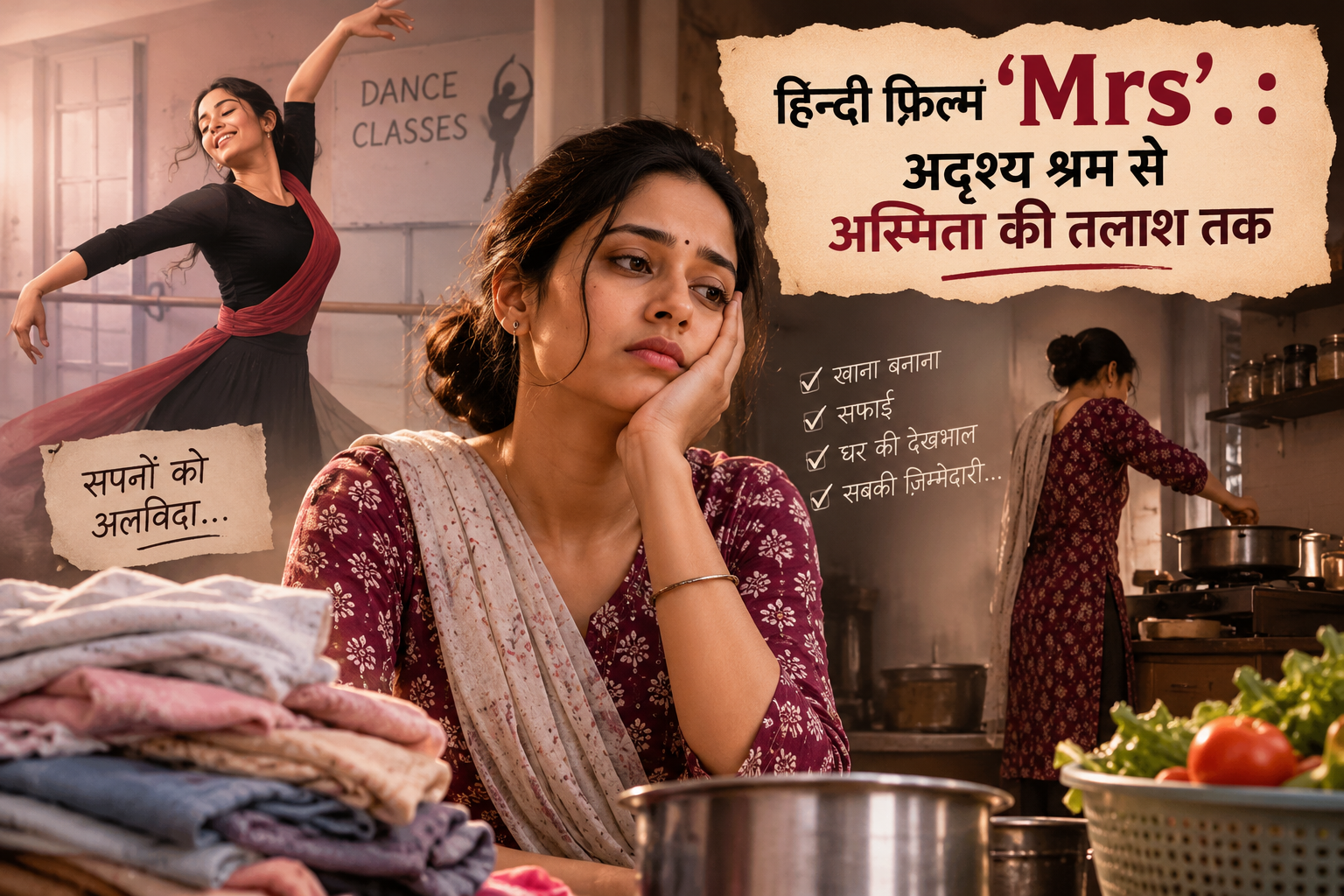
The Hindi film Mrs sensitively explores the invisible labour of women, marital expectations, and the struggle for individual identity. It portrays how domestic responsibilities often compel women to sacrifice their dreams, desires, and personal aspirations. The narrative also examines emotional neglect, inequality, and the disregard for a woman's consent within marriage.
The Hindi Film Mrs.: From Invisible Labour to the Search for Identity
Abstract
A significant part of a woman's life in Indian society is spent fulfilling responsibilities towards her home and family. Cooking, managing the household, attending to family members' needs, and maintaining relationships are integral parts of her everyday life. These activities are often regarded as a woman's duty, and consequently, the labour she performs does not receive the recognition and respect she deserves. The film Mrs. brings this overlooked and unacknowledged labour into focus by connecting it with the question of women's identity.
This research attempts to understand, through the film Mrs., how a woman's individual identity gradually becomes overshadowed by domestic responsibilities after marriage. The experiences of the film's protagonist, Richa, demonstrate that she works throughout the day for her home and family, yet her labour is not given any distinct importance. She is expected to continue performing every task effortlessly, without becoming tired or expressing dissatisfaction. In this context, the question is not merely how much work a woman performs, but also how much her work is noticed, acknowledged, and understood.
Drawing upon the experiences and struggles of the film's principal female character, this study examines domestic labour, gender roles, marital relationships, and patriarchal thinking. It also explores how Richa gradually begins to question the roles assigned to her and attempts to rediscover her preferences, desires, and individual personality. The film suggests that women's freedom does not consist solely of stepping outside the boundaries of the home; it also involves having control over their own time, labour, and decisions.
Therefore, it would be insufficient to view Mrs. merely as the story of a married woman. It also represents the experiences of countless women who, while fulfilling family responsibilities, are often compelled to put their own desires and dreams aside. Richa's struggle is a struggle to rediscover this lost identity. Accordingly, this study seeks to understand the relationship between women's domestic labour, identity, and self-respect in contemporary Indian society through the film Mrs.
Keywords: Women's identity, Invisible labour, Domestic labour, Patriarchy, Gender equality, Institution of marriage, Self-determination, Self-identity.
Research Article
Released on ZEE5 on 7 February 2025 and directed by Arati Kadav, Mrs. tells the story of a woman whose world gradually becomes restricted to the home and kitchen after she marries a doctor. Richa is a trained dancer with dreams and aspirations of her own. However, after marriage, she is expected to cook, clean, attend to her family's needs, and fulfil every domestic responsibility without complaint.
Ironically, her family does not even consider the labour she performs day and night to be genuine work, whereas her husband's professional employment is associated with respect, identity, and economic value. Gradually, Richa realizes that she is not merely managing a household; she is also losing her own identity. The central theme of Mrs. is therefore the struggle surrounding women's invisible domestic labour and identity—a form of labour that families and society frequently regard as a woman's natural duty, overlooking its value and the respect it deserves.
Another important aspect is that Mrs. was released directly on the OTT platform ZEE5 rather than being released in cinemas. The broad reach of OTT enabled the story to reach a large audience, allowing viewers to relate to Richa's experiences and struggles. In this way, the film also demonstrates that OTT has become more than a medium of entertainment: it is now an effective platform for presenting women's experiences and the social questions associated with their lives to a wider audience.
The Emergence and Development of OTT Platforms
In the twenty-first century, technology has significantly transformed human life, including the ways in which people access entertainment. The expansion of the internet and digital devices has brought substantial changes to traditional viewing habits. As a result, web series have emerged as an important medium of mass communication.Previously, audiences depended on cinemas or scheduled television programmes for entertainment. Today, however, viewers can watch content of their choice at any time and from any location, according to their convenience. This development has made entertainment more personalised and audience-centred. Web series have also provided a platform for presenting social and cultural subjects and discussing numerous questions associated with contemporary life.
The growing popularity of web series cannot be attributed solely to technological convenience. Another important reason is the availability of diverse content on digital platforms for audiences with different interests and backgrounds. Their popularity is particularly evident among younger viewers, who can select content according to their schedules and preferences.The widespread availability of smartphones and internet access has made this convenience increasingly common. Instead of waiting for a programme to be broadcast at a particular time, viewers can watch a story at their own pace. This shift has changed the traditional structure of entertainment and established digital platforms alongside cinema and television as an important part of the entertainment industry.
OTT platforms developed within this digital environment. By delivering web series and other audiovisual content directly to viewers, these platforms have significantly expanded access to entertainment.In general, OTT refers to digital platforms that deliver content directly to audiences through the internet. Viewers do not need to depend on scheduled television broadcasts or cinema screenings. Films, web series, documentaries, music, news, interviews, and other forms of content are made available through these platforms.
One of their most important characteristics is that viewers can select content according to their own convenience and interests. This on-demand facility has transformed the relationship between audiences and the content they consume. Defining OTT, Anil Kokaram writes that:
OTT refers to media and entertainment services delivered directly to consumers through the internet.¹
To understand the popularity of OTT in India, it is also necessary to consider the expansion of internet access and the increasing availability of digital technology. As internet access became more widespread, mobile data became less expensive, and smartphone usage increased, the audience for digital platforms continued to grow.In his book Over the Top: OTT Ka Mayajaal, Anant Vijay discusses the development and growing acceptance of OTT in India.He observes that:
OTT is a relatively new medium of entertainment in the country and that its reach has expanded because of increasing internet penetration and cheaper data. The nationwide lockdown during the COVID-19 pandemic further popularised the medium, as people confined to their homes increasingly relied on digital platforms for entertainment. The continued uncertainty surrounding the pandemic kept many viewers away from cinemas for an extended period. The relatively high cost of cinema tickets also encouraged some audiences to wait for films to become available on OTT platforms.²
The emergence of OTT in India was not sudden. Rather, it developed gradually alongside the growth of digital media. The expansion of OTT platforms became particularly noticeable after 2014, when both Indian and international services reached Indian audiences.Increasing internet access, the expansion of 4G services, and the subsequent arrival of 5G technology accelerated this process. Easy access to entertainment through smartphones also helped OTT reach a wider audience, extending beyond urban areas.
The impact of OTT has not been limited to changes in viewing habits. It has also influenced storytelling and the selection of subjects explored in films and series. Traditional media productions often had to account for censorship, commercial interests, and fixed time constraints when presenting social issues. The expansion of digital platforms gave creators comparatively greater freedom to explore subjects that had previously received limited attention.Issues such as gender inequality, patriarchal attitudes, women's freedom, sexuality, mental health, and political and social dissent have consequently become more visible in web series and other digital content.From this perspective, OTT cannot be understood merely as a medium that provides entertainment. It has emerged as a digital space in which social experiences, questions, and inequalities can be presented through storytelling.
OTT has been particularly significant for women-centred narratives because it creates opportunities to bring women's experiences to audiences—experiences that have often been treated as private or domestic matters and excluded from public discussion.Thus, the development of OTT provides an important basis for understanding not only the changing nature of entertainment but also broader changes in social and intellectual expression.Viewed within this context, Mrs. illustrates an important aspect of women-centred storytelling on OTT platforms.
In the film, patriarchy does not appear only through a single dramatic act of oppression. It is also reflected in everyday decisions, expectations, and behaviours.Important decisions concerning Richa's life are frequently made not by Richa herself but by her husband, Diwakar, and her father-in-law, referred to as Papaji. They determine what she should do, how the household should be managed, and what her priorities ought to be.
Richa has very little freedom to express her preferences or disagreement. Before marriage, she was an independent woman who danced and pursued her own interests and dreams. After marriage, she gradually becomes so occupied with domestic responsibilities that her personal desires recede into the background.From the perspective of patriarchal society, Richa's situation reveals the reality of this social structure in an understated but powerful manner.
According to Simone de Beauvoir, patriarchal society is a social system in which men are regarded as superior, powerful, and entitled to make decisions, while women are placed in subordinate positions. Within this system, a woman's identity is defined in relation to men rather than being recognised independently.In her influential book The Second Sex, de Beauvoir expresses this idea through the statement:
“One is not born, but rather becomes, a woman.”³
Richa's character in Mrs. experiences this social construction directly. Before marriage, she is a woman with her own preferences, dreams, and personality. After marriage, however, she is expected to mould herself into the roles of an “ideal wife” and an “ideal daughter-in-law.”A statement made by Diwakar brings this patriarchal attitude into focus through an apparently ordinary conversation. When Richa's difficulties with domestic work become evident, Diwakar casually remarks that:
The task is “a piece of cake” for her.⁴
This statement reflects a mindset in which domestic labour is assumed to be natural and easy for women.In reality, Richa spends the entire day performing household tasks and becomes physically and mentally exhausted while fulfilling these responsibilities. For Diwakar, the work appears effortless because he does not participate in it. For Richa, however, the same work determines how she spends her entire day and how much energy she has left.The film therefore demonstrates that patriarchy does not always operate through explicit commands or severe forms of control. It can also be embedded in ordinary statements and behaviours that families themselves come to regard as natural.
Kamla Bhasin explores this broader structure of patriarchy in her book:
What Is Patriarchy? She explains that patriarchy is a system in which men exercise control over women's labour, bodies, sexuality, and decisions. Men are granted greater access to power, property, and decision-making, while women's lives and choices are regulated through various social norms.⁵
Richa's life in Mrs. provides a vivid illustration of this concept. Her family determines how she spends her time, her labour is treated as a duty, and her desires are placed behind the needs of the household.The film thus presents patriarchy not as an extraordinary or distant social problem, but as a set of everyday expectations within the home through which a woman gradually becomes disconnected from her own sense of self.In Mrs., the word “Mrs.” is not merely a title added to a woman's name after marriage. It gradually becomes a symbol of the social identity and role imposed upon her.
From the beginning, the film reveals the contrast between Richa's personality and the family environment surrounding her. On one hand, dancing allows Richa to express herself and feel comfortable with her interests and individuality. On the other hand, her mother is occupied with preparations for Richa's marriage.Marriage may be a natural part of life for Richa, but the environment around her has already begun to determine the direction her life is expected to take afterwards.
When Diwakar and his family visit to meet Richa as a potential bride, she openly expresses her preferences during their first conversation. She casually mentions that she likes pizza and cassata ice cream. However, rather than showing genuine interest in her preferences, Diwakar begins imposing his own choices on her.When Richa expresses her preferences during her first meeting with Diwakar, he responds by recommending that she try something he likes instead. His remark:
“Why don't you try this too?”⁶
may appear harmless, but it reveals an important inequality in their relationship.
Instead of being equally interested in what Richa wants, Diwakar places greater importance on his own preferences. This small interaction anticipates the larger social and marital behaviour that develops later.After the marriage is arranged and the wedding takes place, this difference becomes increasingly apparent.When Richa's father-in-law welcomes her into the family by saying-
“Welcome to the family; you are now our daughter,”⁷
the statement initially sounds affectionate and accepting. However, as the film progresses, it raises an important question: What does it actually mean to treat someone as a daughter?If Richa is considered a daughter, should her preferences, work, dancing, and independence not also be accepted? Yet her desire to work after marriage is not readily welcomed, and restrictions are placed on dancing, which was an important part of her identity before marriage.
Gradually, she is made to feel that her priorities no longer belong to her. Household management, family needs, and her husband's expectations become the centre of her life.The contrast between calling Richa a daughter and actually treating her like one is therefore presented subtly but effectively.The scene in which wedding gifts are opened also reveals the same mentality. When Diwakar notices the gifts intended for Richa, he remarks:
“All of these are for you. There is nothing here for me.”⁸
The statement is not simply about the gifts. It reflects an expectation that the husband should remain at the centre of every aspect of his wife's life.Instead of focusing on what Richa has received, what makes her happy, or what she likes, Diwakar is concerned about what the gifts contain for him.Even in this small domestic incident, the husband's expectations take precedence over Richa's happiness and desires.
The film demonstrates that patriarchy does not always appear through major or explicit acts of opposition. It often enters women's lives through conversations, preferences, advice, restrictions, and everyday expectations.Consequently, the word “Mrs.” gradually becomes more than an indication of Richa's marital status. It represents a broader social role in which a woman is expected to leave her former identity behind and become an “ideal wife” and an “ideal daughter-in-law.”
In the wedding-night scene, Richa moves scattered flower petals aside, and Diwakar enters and sits on the same petals. Concerned that they might leave stains, Richa says, “They will get stained.” Diwakar asks,“What will?” She replies,“The rose petals.” Diwakar responds by suggesting:
A mixture of lemon juice and baking soda, adding that the kitchen is a solution to every problem.⁹
This exchange is more than an ordinary suggestion about removing stains. Within the broader context of the film, the kitchen becomes a symbol.It is as though every problem a woman encounters must be solved within the boundaries of cooking and domestic work. Richa's personality, desires, and individual world become less important than the expectation that she should manage the household.
This idea becomes clearer through the recurring scenes involving tea.During the early days of their marriage, Diwakar gives Richa a little tea from his cup to taste, and Richa adds pieces of almonds to his tea. This small interaction suggests companionship and the possibility of sharing.However, within a few days, the same activity takes on a different meaning. After a meal, Diwakar asks for tea. Richa immediately prepares it and brings it to him, but when he leaves, she is left standing there with the cup in her hand.What initially represented sharing and companionship has gradually become an act of service.
Richa's lack of cooking experience is similarly treated as a deficiency rather than an aspect of her individual personality.When Diwakar discovers that:
She does not know how to cook, he jokes that her résumé had mentioned baking.¹⁰
Beneath the humour lies an expectation that a woman's goodness or suitability as a wife should be connected to her domestic skills.
This expectation becomes even clearer when Diwakar first visits Richa's parental home. Her mother prepares a variety of dishes to welcome him.Diwakar asks Richa's mother whether she has taught Richa to cook these dishes. Her mother replies that she has tried.Diwakar then remarks that:
Whatever Richa's own mother has been unable to teach her, his mother will teach her instead.¹¹
Although the exchange may sound light-hearted, it reveals the patriarchal process through which a woman is expected to be trained for a predetermined domestic role after marriage.Marriage consequently becomes more than a relationship between two individuals. It also becomes a process through which a woman is expected to be moulded into an established household role.During the same visit, the conversation turns to the fact that both Richa and Diwakar are workaholics. Richa's father explains that she is also passionate about her work.Diwakar immediately asks what kind of work she does. When he learns that :
She dances,¹²
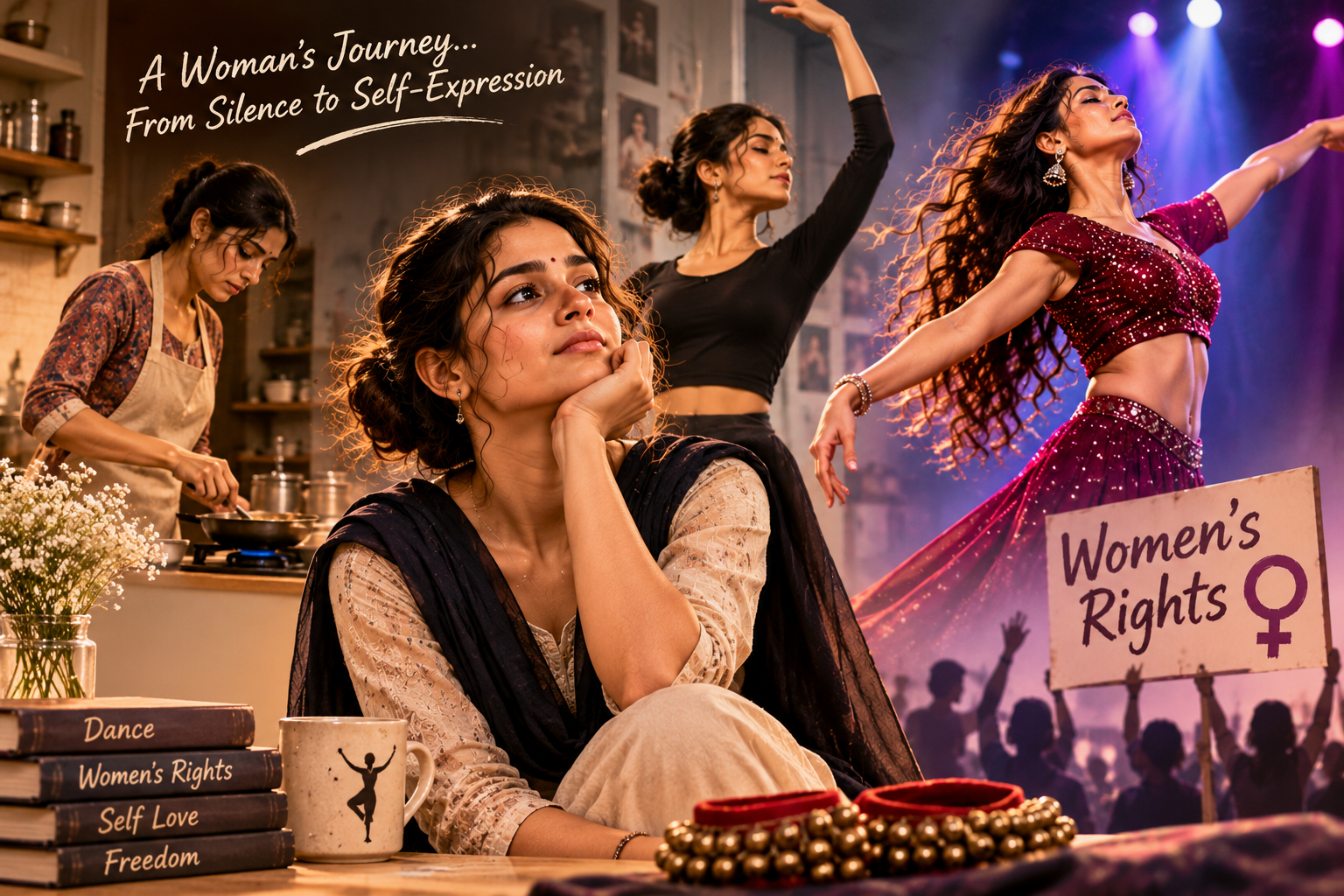
he responds with an unusual laugh.This reaction carries a subtle irony. A woman whose professional ambitions will later be restricted is not even readily recognised as someone engaged in work.The question is not merely what Richa does, but who has the authority to decide whether a woman's labour and talent count as work.For Richa, dancing is an essential part of her personality and self-expression. However, from a patriarchal perspective, her talent is not readily considered work unless it fits a conventional definition of economic or professional employment.
After marriage, repeatedly visiting relatives, eating at their homes, and fulfilling social obligations become part of Richa's routine. Her own preferences are gradually pushed further into the background.One night, the film presents a particularly uncomfortable and important incident.After returning home, Richa is not ready to engage in sexual activity. She tells Diwakar that they can do it the following day.He responds by asking what will happen if he is not in the mood the next day. Richa suggests that:
They can wait another day.¹³
Instead of understanding and accepting her reluctance, Diwakar sends her outside on a pretext. When she returns, he closes the bedroom door and has sexual relations with her against her will.The central issue in this scene is that physical intimacy is driven not by love, communication, and mutual desire, but by a sense of entitlement. Richa's willingness or unwillingness is not given importance.Later, Richa herself recognises the absence of love and emotional closeness in the experience.
Through this scene, the film raises the question of consent within marriage—a question that is often ignored when sexual access is treated as a husband's natural marital right.At around half past midnight, another scene in the household unfolds. Diwakar's mother is still awake and occupied with domestic work. At six the following morning, she gets up and first brings her husband's slippers and prepares ajwain water for him.The scene becomes especially significant when the audience later learns that she holds a PhD in Economics.
Despite her education and intellectual abilities, her role within the household has been defined in such a way that fulfilling even her husband's smallest needs has become her responsibility.The film raises an important question: If even a highly educated woman cannot escape patriarchal domestic roles, is the problem simply a lack of education, or does it lie in the social structure that teaches women to accept service as an expression of love, duty, and good upbringing?
Bringing a husband his slippers or anticipating his needs before he leaves the house may not seem unusual in isolation. However, when such behaviour is expected exclusively from women, it can reflect a culture of dependence and service rather than an equal relationship.The following morning further demonstrates this dependence. Diwakar calls out to Richa and asks her to lay out his clothes.The expectation goes beyond clothing and extends even to providing his undergarments. The question is not whether a wife can perform a task for her husband. It is why the ordinary needs of an able-bodied adult are automatically treated as another person's responsibility after marriage.The film brings attention to these everyday habits, which are often overlooked because they are considered normal.
Gradually, marriage becomes less a relationship of companionship for Richa and more a routine of service.This is where the symbolic meaning of “Mrs.” becomes even more significant.Less than a week has passed since the wedding when Diwakar's mother leaves to visit her daughter. Richa is suddenly expected to manage the entire household.The expectation that a newly married daughter-in-law should quickly become proficient in every domestic task is revealed through a series of small incidents.
One day, Richa accidentally adds sugar to a bitter-gourd dish, prompting a sarcastic remark from her father-in-law about having something sweet so early in the morning.When she prepares chutney in a mixer instead of using a traditional grinding stone, he refuses to eat it. He also prefers freshly prepared, hot rotis rather than those that have already been made.
No matter how much work Richa performs, her efforts are not readily accepted. Instead, her mistakes and shortcomings are continually highlighted.Meanwhile, as Diwakar leaves for work, he asks Richa to give him her “sexiest smile.” Richa replies that she smells like a chef.Diwakar responds that:
She smells like a kitchen and that it is the sexiest smell in the world.¹⁴
On the surface, the exchange sounds romantic. However, in the wider context of the film, the kitchen repeatedly becomes a substitute for Richa's entire world.Her identity, labour, and even her attractiveness are increasingly associated with cooking and domestic service.After Diwakar and his father leave the house, Richa briefly returns to the person she was before marriage. She laughs freely, puts on her headphones, and dances, enjoying the enthusiasm that has been suppressed since the wedding.
Her father-in-law returns to the house looking for his slippers and sees her dancing. He becomes displeased and walks away, saying only, “Nothing.”His apparently insignificant remark reveals a great deal. He does not see Richa's dancing as an expression of joy or talent; he sees it as a distraction from household duties.A similar pattern emerges when Richa attempts to prepare biryani for the first time. Despite her effort, she receives no praise. Her father-in-law declares that what she has prepared is pulao rather than biryani.He later complains to his wife that she has not taught her daughter-in-law how to make biryani.His wife responds that they can manage with pulao for a few days. However, he insists that Richa must be taught how to run the household properly, adding that his allergy is aggravated by dusting and that even this task is not being performed adequately.This exchange makes it clear that Richa is expected not merely to cook but to maintain the entire household according to a prescribed standard.
The next day, Richa watches a video on her phone to learn how to prepare dum biryani. She makes a determined effort to ensure that her husband and father-in-law enjoy the meal.Yet, even after all her effort, she receives criticism rather than satisfaction.Diwakar casually says that:
The dish has been overrated. When Richa asks her father-in-law how the food is, he requests raita instead of praising the biryani and then complains that it lacks salt.¹⁵
The disappointment on Richa's face reveals that she is not merely cooking; she is also continually searching for acceptance and appreciation.That evening, despite the considerable amount of biryani remaining, Diwakar prefers to eat kadhi and fresh rotis.Eventually, Richa tells her mother that there is too much work and asks how she can manage everything alone. She asks whether she should hire a domestic worker.Instead of supporting her, her mother discourages the idea, arguing that:
Because the marriage is new, Richa should not do anything that might disrupt the household arrangements.¹⁶
Even her parental home sends her the message that she must make the greater effort to adjust to her new family.Throughout this domestic routine, the film repeatedly shows water leaking from the kitchen sink.At first, only a few drops are visible. Gradually, the problem worsens until the sink eventually becomes clogged.The recurring image becomes a subtle metaphor for Richa's situation.Small acts of neglect and pressure may initially appear insignificant, but over time they accumulate until the burden becomes overwhelming and begins to affect an individual's entire life.
During this period, Richa meets a young girl named Savi.On Karva Chauth, Savi explains that her mother does not wear a bindi because, according to her understanding, only women who are considered lucky wear one.Richa explains that everyone has good fortune. Savi then innocently remarks that a woman without a husband does not have good luck either.Her comment reveals a deeply rooted social belief in which a woman's fortune, identity, and social value are linked to the presence of a husband.Richa challenges this belief.She asks Savi whether she knows what prime numbers are—numbers that do not need other numbers to be added to themselves in order to have their own identity.She then tells Savi that her mother is like a prime number.When Savi asks whether her mother also has good luck, Richa replies that:
Her mother is herself a source of good fortune.¹⁷
This brief exchange presents an important aspect of the film's feminist perspective: a woman's completeness is determined not by the presence of a man but by her own existence and identity.Richa's Growing Awareness and Resistance.Richa later sees her friend Bubble progressing in the field of dance, supported by a husband who encourages her career.Witnessing this partnership creates a sense of unease and even jealousy in Richa because her own experience is the opposite. In an emotional moment, she blocks Bubble but later unblocks her.This small incident reveals Richa's inner struggle. She is not truly angry with her friend; she is confronting the deprivation she experiences more intensely when she sees a different kind of life being lived by someone else.One day, when sweat stains appear on her father-in-law's kurta, Richa instinctively repeats Diwakar's earlier remark:
“Two parts lemon juice and one part baking soda. The kitchen is a solution to every problem.”
She then begins cleaning the kurta herself.By this point, the statement has become a form of irony rather than a genuine solution. Why must every problem ultimately be resolved through the kitchen, cleaning, and women's labour?Between constant work, expectations, and neglect, Richa becomes so exhausted that she gradually loses the desire for intimacy with Diwakar. Instead of joining him, she prefers to sleep on the sofa.
When her period begins the following morning, Diwakar expresses surprise that pregnancy has not occurred, saying that they had done everything perfectly.For him, conception appears to be the predictable result of a planned process. Richa's desires, mental state, and consent are nowhere to be seen.The scene makes the absence of independent recognition for women's wishes within marriage particularly clear.The arrival of a domestic worker introduces another perspective.When Richa begins helping the woman, the worker remarks that the women of this household rarely get an opportunity to rest, so Richa should make the most of it while she can.¹⁸The worker also explains that the family is constantly critical and practises untouchability, which is why domestic workers do not remain in the household for long.Even when the worker hands over a vessel containing milk, it is wiped with a cloth afterwards.
Richa begins to understand that the domestic system in which she herself feels trapped has also shaped the lives of other women who came before her. They, too, have had to live between household work and restrictive rules.The most ironic aspect is that Richa's father-in-law repeatedly asks how long the domestic worker has been employed.As soon as he learns that several days have passed, he appears satisfied that Richa will soon resume managing the household herself.The brief rest Richa receives is therefore not a permanent right but a temporary reprieve.After her period ends, Richa once again puts her heart into preparing dal-pittha. Somewhere within her, she hopes that her efforts might finally be appreciated.
However, Diwakar mocks her by suggesting that it takes talent even to ruin his mother's special recipe.His later explanation that he was only joking does not erase the hurt caused by his remark.Even when relatives visit, Richa's role remains almost entirely restricted to cooking and hospitality. From preparing lemonade to serving it, every small aspect of her work is judged.When she tries to return to dancing and her future ambitions, she is reminded that:
Her mother-in-law holds a PhD in Economics but nevertheless chose to prioritise her family and children.¹⁹
Although the statement is not an explicit prohibition, it contains a clear social expectation: after marriage, a woman should choose her family before her dreams.The continuous workload, neglect, and lack of space for her desires eventually leave Richa emotionally overwhelmed, and she breaks down in tears when alone.When Richa and Diwakar visit the home of Richa's friend Babble, Richa immediately notices Diwakar helping with household tasks.She casually remarks that he is helping so much there, whereas he never helps in the kitchen at home.Instead of recognising the imbalance, Diwakar becomes defensive and asks whether she is claiming that he never helps her.Richa reminds him that at home he sits with his father, eats with him, and then leaves, while almost all responsibility for the house and kitchen falls on her.As the argument escalates, Richa tells him that he has effectively acquired a free domestic worker.Diwakar interprets this as an attack on his masculine pride. He responds by asking whether he married her merely to obtain a free cook and housekeeper, and why she is humiliating him in front of his friends.²⁰ Once again, Richa's actual complaint—her labour and exhaustion—is pushed aside, while Diwakar's wounded ego becomes the centre of attention.Instead of accepting responsibility, he eventually persuades Richa to accept that she was at fault.
Physical intimacy follows this tense situation, but it contains neither emotional closeness nor genuine consideration for Richa's wishes and needs.Some time later, Diwakar asks Richa to pack his belongings and attempts to approach her intimately. This time, she stops him.For the first time, the pain she has kept suppressed emerges clearly in words.Richa tells him that sex is not only for having children. Diwakar replies that they are married and therefore need to plan for a child.Richa explains her physical and emotional discomfort. She tells him that the mechanical way in which they have sex causes her pain and asks whether he cannot understand or even notice it.She further explains that intimacy should not be treated as a task that must simply be completed. There should be closeness first, and her desires must also matter. She objects to the way he always begins and ends the act without considering her experience.Instead of understanding her concerns, Diwakar sarcastically suggests that:
She is experienced and an expert.²¹
Richa's attempt to express her sexual desires is thus used against her.The kitchen, which Diwakar had once described as having the most attractive smell in the world, becomes another means of belittling her.The scene makes clear that the problem does not lie in Richa's desires but in a mindset that accepts women's desires only when they correspond to men's wishes.After Karva Chauth, Richa shows Diwakar videos of herself dancing. However, instead of sharing her happiness, Diwakar worries about his reputation.He tells her to delete the videos because someone might see them and he might be humiliated.The following day, during his father's birthday celebration, relatives tease Diwakar about Richa's dancing. One asks whether he remembers a particular dance step, while another points out that it is his wife's step.Diwakar becomes angry with Richa again and goes into the kitchen to reprimand her.She is asked to prepare lemonade for the guests. This time, however, Richa fills the glasses with water leaking from the sink, which has remained unrepaired for so long, and presents it as lemonade.The scene represents the culmination of her accumulated frustration and rebellion.
The family's reputation, her husband's reputation, and the opinions of the guests have become secondary to her desire to escape the suffocating circumstances of her life.She picks up the keys, gets into the car, and drives away towards her parental home, crying.This is not merely the moment when she leaves a house. It is her first attempt to escape the imposed identity of “Mrs.”—an identity in which being a wife has come to mean continually suppressing her desires, labour, and individuality.
After returning to her parental home, Richa breaks down in front of her mother and shares the experiences she has endured.Despite hearing everything, her mother's first response is that:
It is Richa's home and that nobody should leave a household over such a small matter. She offers to accompany Richa back and apologise on her behalf.²²
Calling the situation a “small matter” reduces Richa's accumulated suffering to an ordinary domestic disagreement.Instead of understanding the seriousness of the psychological and emotional pressure she has experienced, her mother advises her to return and compromise once again.At that moment, her mother tells Richa to get water for herself and her brother.Richa's accumulated anger finally erupts. She shouts:
Parents like hers have spoiled their sons by constantly favouring them. She points out that she is also a daughter, yet respect is given to sons. The respect granted to sons should also be given to daughters.²³
This statement is not merely a complaint against her mother. It challenges the broader family and social mentality in which sons are raised to expect service while daughters are taught to provide it.For the first time, Richa explicitly insists that respect should not be a privilege inherited through gender.Immediately afterwards, the film moves forward in time and reveals that Diwakar has married again.He appears to be living the same kind of marital life with his new wife, in which the wife's role revolves around domestic service.When his new wife brings him a hot roti and apologises because the first one was burnt, Diwakar casually reassures her that:
The first roti is often burnt and the second one turns out better.²⁴
This exchange becomes a powerful form of irony.The behaviour that Diwakar treated as normal in his relationship with Richa is repeated in his new marriage.The film thereby suggests that the problem was not a particular woman or an individual marriage. It lay in a mindset that regards a wife primarily as someone responsible for domestic duties rather than as an equal partner.
In contrast, Richa's life has moved in an entirely different direction.The woman who once faced ridicule and restrictions because of her dancing is now progressing in her career and performing on stage.She also invites Savi and Savi's mother to her programme. This is particularly significant because Diwakar's family had previously refused to allow Savi's mother into their home because of caste-based discrimination and social prejudice.The scene gives Richa's journey a deeper meaning.She has not merely left her marital home. She has also found the courage to move beyond a mentality that treated her labour as a duty, her talent as a hobby, and her desires as selfishness.
Conclusion
At the beginning of the film, “Mrs.” represents an identity for Richa associated with domestic responsibilities, sacrifice, adjustment, and silence.By the end, she crosses the boundaries of this imposed identity and begins to reclaim her individuality.Her struggle is not simply about leaving the kitchen. It is about being recognised as an independent person in her own right.In this sense, the title Mrs. does not represent a fixed identity. Instead, it becomes a symbol of a journey from invisible labour to the recovery of selfhood.Richa ultimately decides that she is not merely someone's wife or daughter-in-law. She is also an independent woman with her own desires, talents, and decisions.
References
- Anil Kokaram, Regis Crinon, and Nicolas Catania. “OTT (Over-The-Top) in 2015.” SMPTE Motion Imaging Journal, 2015.
- Anant Vijay. Over the Top: OTT Ka Mayajaal. Prabhat Prakashan, 2023.
- Simone de Beauvoir. The Second Sex. Translated by H. M. Parshley. New York: Vintage Books, 1989, p. 283.
- Dialogue between Diwakar and his elder brother, 2025, 1:05:00–1:05:36.
- Kamla Bhasin. What Is Patriarchy? New Delhi: Kali for Women, 1993.
- Dialogue between Diwakar and Richa, 2025, 05:08–05:36.
- Diwakar's father welcomes Richa, 2025, 06:27–06:31.
- Diwakar and Richa opening gifts, 2025, 11:02–11:05.
- Dialogue between Diwakar and Richa while opening gifts, 2025, 00:09:50–00:10:36.
- Diwakar's sarcastic remark to Richa, 2025, 00:15:35–00:15:49.
- Dialogue between Diwakar and Richa's mother at the dining table, 2025, 00:16:42–00:17:13.
- Dialogue between Diwakar and Richa's father at the dining table, 2025, 00:16:42–00:17:13.
- Dialogue between Richa and Diwakar, 2025, 00:18:20–00:18:50.
- Dialogue between Richa and Diwakar before he leaves for the clinic, 2025, 00:33:47–00:33:50.
- Richa expresses her emotional distress and discusses the lack of appreciation with her father-in-law, 2025, 00:41:45–00:42:53.
- Telephone conversation between Richa and her mother, 2025, 00:44:10–00:45:02.
- Dialogue between Richa and Savi, 2025, 00:47:42–00:48:37.
- Dialogue between Savi's mother and Richa, 2025, 00:56:54–00:56:56.
- Dialogue between Richa and her father-in-law, 2025, 01:09:10–01:09:13.
- Dialogue between Diwakar and Richa, 2025, 01:13:16–01:13:36.
- Dialogue between Richa and Diwakar, 2025, 01:17:39–01:20:20.
- Richa angrily speaks to her family, 2025, 01:35:34–01:35:39.
- Dialogue between Richa and her mother, 2025, 01:35:58–01:36:10.
- Dialogue between Diwakar and his new wife at the dining table, 2025, 01:36:34–01:37:17.